“We know where they are”
On the evening of 7 April 2025, the commander of the Israeli Air Force, Tomer Bar, sat with the Chief of Staff, Eyal Zamir, in an office in Tel Aviv’s Kirya compound. Across from them were reservist officers who had drafted a letter against the war in Gaza. Around a thousand current and former Air Force personnel would eventually sign it. Their central concern was not politics. It was that the fighting was putting the hostages at risk.
According to a person present, Bar’s answer was unequivocal: “There won’t be any harm to the hostages. We know where they are.” When the reservists pushed back, a former Air Force commander brought in to help, Ido Nehoshtan, scolded them: “You think you know better than the Air Force chief about our ability to avoid harming the hostages?”
One week later, an Israeli jet struck a building in Gaza. Beneath it ran a tunnel where Edan Alexander and Matan Zangauker were being held. The army had not known they were there. Part of the tunnel shaft collapsed as the two men fled with their captors. “We dug ourselves out of there before everything collapsed on us,” Alexander later told his father.
Both men survived. Many did not.
What this piece argues, and what it doesn’t
Our previous piece, The Hannibal Directive and October 7, documented a named order. On 7 October 2023, the IDF applied a doctrine designed to stop soldiers and civilians being taken into Gaza, accepting that the people being taken might die in the attempt. Yoav Gallant later confirmed, in a Channel 12 interview on 6 February 2025, that it was issued “tactically” and “in various places” that day.
This piece makes a narrower claim, and it is important to be precise about it. No source we have found says the Hannibal Directive was formally invoked inside Gaza after 7 October. What the record shows is something else: the same ordering of priorities, carried on as policy for two years. The military objective came first. The hostages’ survival was a factor to be weighed against it, not a condition on it.
We are not the first to draw the connection. Yagil Levy, a sociologist at the Open University of Israel, wrote in Haaretz that the decision to attack Gaza despite the presence of hostages at bombed sites “can be considered an extension of the ‘Hannibal’ directive — that is, an attempt to thwart the continuation of captivity even at the cost of endangering the lives of the hostages.”
How a strike was cleared
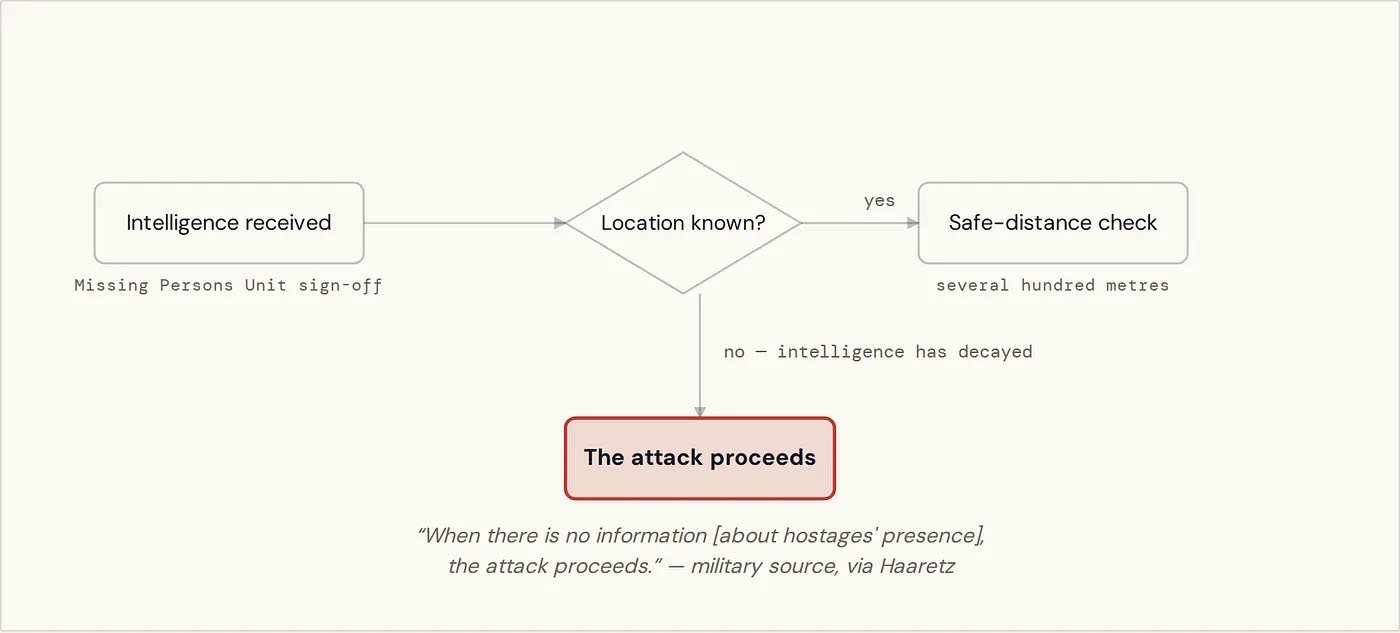
The IDF did not ignore the hostages. From the start of the war it tried to track where they were held, and every strike in Gaza required sign-off from the army’s Missing Persons Unit, which ran an operations centre around the clock. A military source told Haaretz that hundreds of strikes were called off because of concerns about hostages nearby.
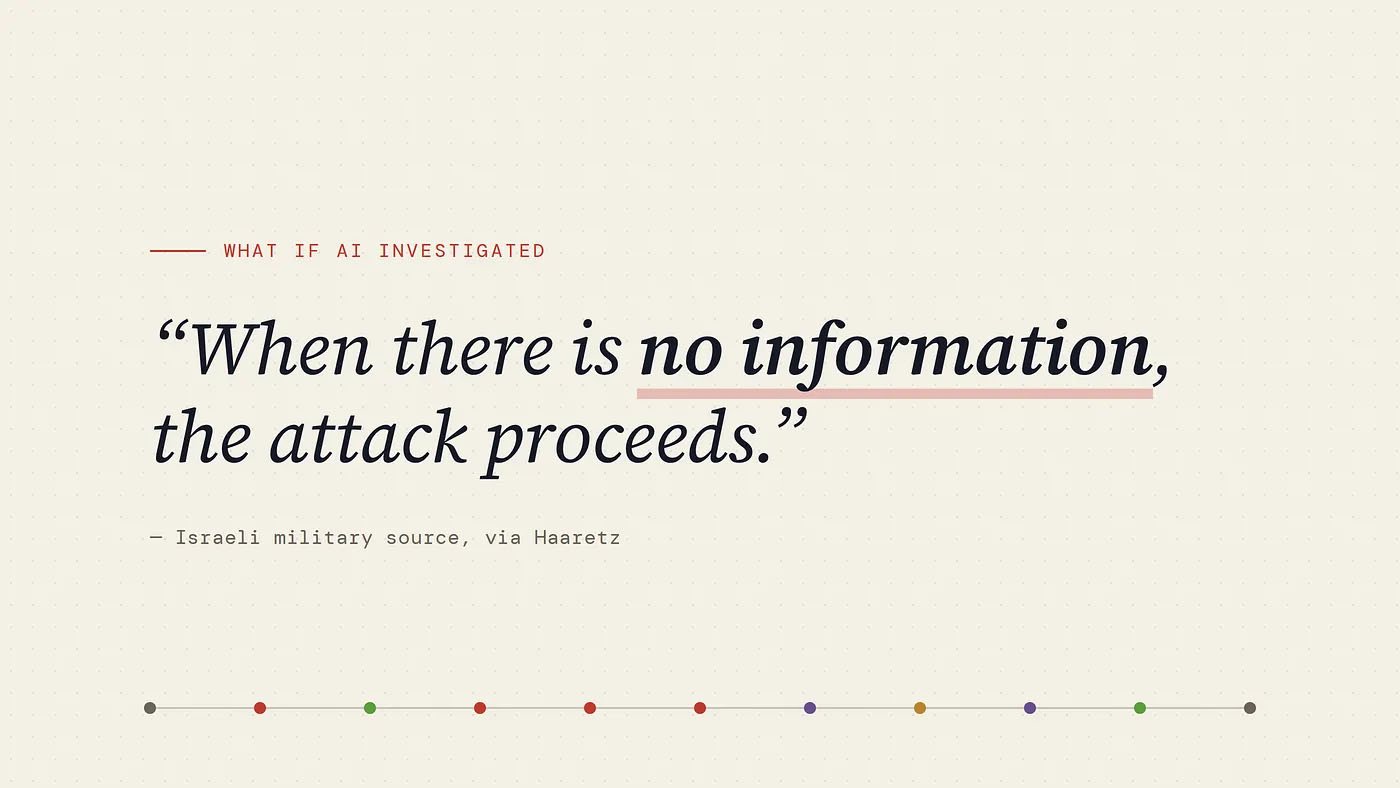
But the system had a threshold, and the threshold is the story. The IDF authorised strikes at a “safe distance” of several hundred metres from known hostage locations, with the distance set by the size and type of munition. Known is the operative word. “The more strikes there are, the greater the risk,” one military source said. “When there is no information [about hostages’ presence], the attack proceeds.”
And information decayed fast. Intelligence on a hostage’s location, the same source explained, was accurate only at the moment it was received. Once captives were moved, the army was effectively blind.
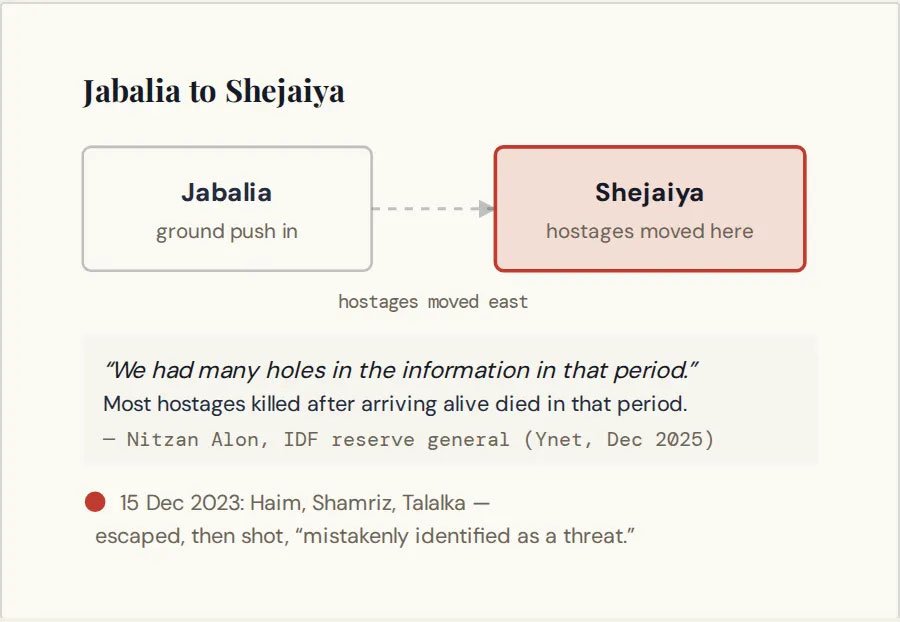
They were moved constantly. Nitzan Alon, the reserve general who headed the IDF’s hostage headquarters, described one such period to Yedioth Ahronoth. When Israeli forces pushed into Jabalia, Hamas moved the hostages east to Shejaiya. “We had many holes in the information in that period,” Alon said. “Most of the hostages who were killed after arriving alive in Gaza were killed in that period.”
Even when the army did know, knowing had limits. Alon described the case of Chen Goldstein-Almog. Her location was known, and the house she was held in was marked as off-limits for strikes. A building a hundred metres away was destroyed anyway; the windows in her house shattered and the walls shook. “The fear caused by our own airstrikes came up again and again in hostages’ accounts,” Alon said.
All of that can be true at once. A system can prevent many deaths and still build others into its design. The question is what it was designed to prioritise when the information ran out. The answer, in the IDF’s own words, is that the attack proceeds.
The record

Haaretz’s investigation, published in May 2025, found that over 601 days of war, Israeli military operations endangered at least 54 hostages and killed at least 20. The paper describes those figures as an underestimate: they rely on the IDF’s own investigations and exclude four hostages whose circumstances of death remain unclear.
The deaths do not all have the same cause, and they should not be counted as if they do. What follows separates them.
Killed by Israeli fire
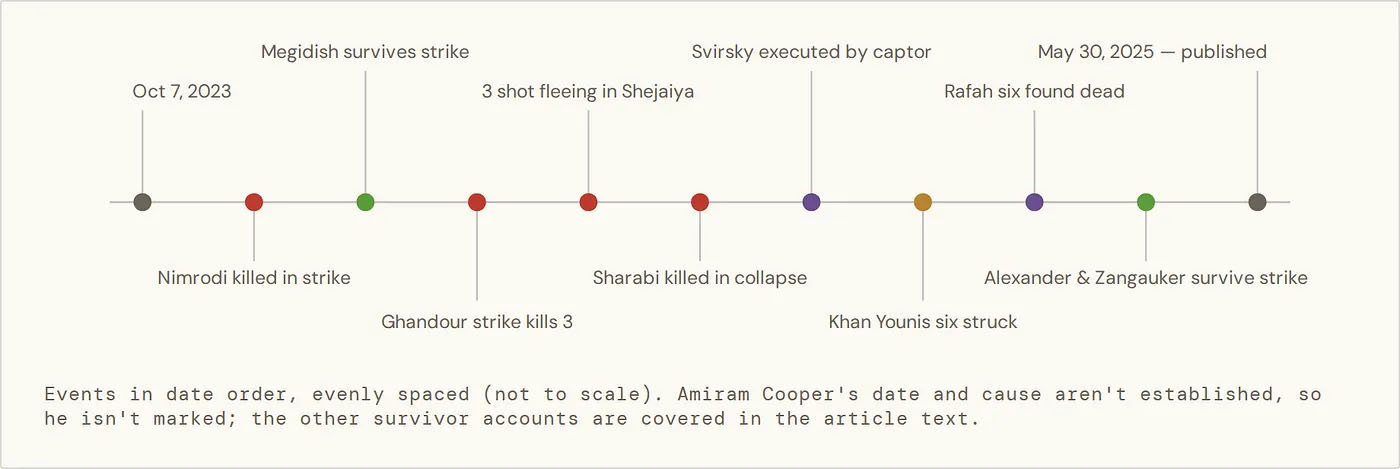
Ron Sherman, Nik Beizer and Elia Toledano. On 10 November 2023, the Air Force struck the compound of Ahmed Ghandour, commander of Hamas’s Northern Brigade. In September 2024, after months of pressure from the families, the IDF concluded there was a “high probability” the three hostages had died as a “byproduct” of that strike, suffocated by gas released in the tunnel. The army said it had no information they were there; in fact, it had information suggesting they were somewhere else, so the area was never designated as one where hostages might be.
Ron Sherman’s mother, Maayan, said the family had received a Hamas leaflet on 1 November carrying Ron’s picture and warning that Israeli bombardment would kill him. Nik Beizer’s mother, Katy, told the Times of Israel she found it hard to believe the army had not considered that captives might be held near a senior commander. Ron Sherman’s gravestone, as photographed by Haaretz, reads: “Abandoned and sacrificed by the government of destruction.”
Tamir Nimrodi. An 18-year-old soldier taken alive from his base near the Erez crossing on 7 October. After his body was returned in October 2025, the IDF assessed with “high probability” that he was killed in an Israeli airstrike on 9 October 2023, two days into the war, while in captivity. Hamas had claimed as much on 14 October 2023; Israel never confirmed it until his body came home. Nitzan Alon has said Nimrodi was killed in an airstrike on a building Israel did not know he was being held in: “The house he was in was destroyed from the air. We didn’t know he was there.” (Times of Israel, Ynet)
Yossi Sharabi. In January 2024, Sharabi was held in a building with Itay Svirsky and Noa Argamani. A missile aimed at a neighbouring building brought theirs down through a connecting wall. Sharabi was most likely killed in the collapse. Svirsky, who was lightly wounded, rescued Argamani from the rubble with another hostage’s help.
Yotam Haim, Alon Shamriz and Samer Talalka. Covered in our previous piece: on 15 December 2023, having escaped their captors, the three approached Israeli soldiers in Shejaiya shirtless, carrying a white flag and calling for help in Hebrew, and were shot dead. The IDF acknowledged they were “mistakenly identified as a threat.” Nitzan Alon has described it as a matter of discipline rather than hostage policy. We include it here because the category is deaths by Israeli fire, whatever the cause.
Mixed cause
The Khan Younis six. Yagev Buchshtab, Yoram Metzger, Nadav Popplewell, Alex Dancyg, Haim Peri and Avraham Munder were held first in a large Hamas tunnel in Khan Younis. Around the turn of 2024, the IDF could not pin down exactly when, they were moved to a smaller transit tunnel in the Hamad neighbourhood about four kilometres away. On 14 February 2024, the Air Force struck that tunnel to kill Hamas battalion commanders gathered there. Neither the Air Force nor Southern Command knew the hostages had been moved to it.
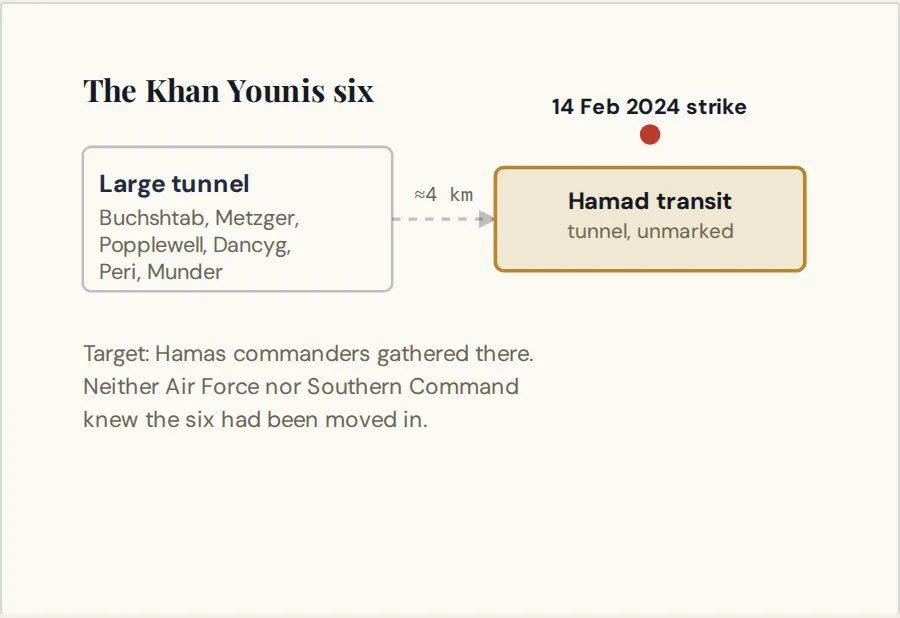
The joint IDF and Shin Bet investigation, published in December 2024, found that the six hostages had gunshot wounds. The six guards found beside them had none; they had died of suffocation caused by the strike. The conclusion: the hostages were most likely shot by their captors during the strike, and the army believes that even had they not been, the strike would have killed them regardless. The IDF said that had there been any doubt about hostages being present, the tunnel would not have been attacked, and that lessons had been learned.
Executed by captors amid Israeli military activity
Itay Svirsky. After surviving the collapse that killed Sharabi, Svirsky was moved with Argamani to another location. According to Argamani, the two had begun planning to persuade their captors to let them record a video asking Israel to stop the airstrikes. When they arrived at the new apartment, a captor took Svirsky into a room and executed him. Army officials told the family they believed the captor, fearing capture, did not want to keep fleeing with two hostages.
His sister, Merav, told Haaretz what the army then admitted: “The army officials admitted they hadn’t known they were there and told us that procedures were changed as a result. They explicitly acknowledged that they hadn’t conducted a thorough enough check. We were told the hostages were being protected, that their locations were known, and that no strikes would be carried out in areas where hostages were present, and that if a strike was necessary, it would be preceded by rigorous review. That didn’t happen.”
The Rafah six. Hersh Goldberg-Polin, Eden Yerushalmi, Ori Danino, Alex Lobanov, Carmel Gat and Almog Sarusi were found dead in a tunnel in Rafah at the end of August 2024. A military inquiry concluded they had been killed by their guards as Israeli forces advanced. The New York Times reported that Israeli defence officials knew the army was taking a risk with hostages by operating in that area. Nitzan Alon has pointed to the contrast with an earlier operation: in December 2023, special forces entered a Rafah tunnel holding twelve hostages, and none were killed.
Amiram Cooper. Cooper, 84, from Kibbutz Nir Oz, was assessed by the IDF to have been killed in captivity in the Khan Younis area; reports differ on whether he died in December 2023 or February 2024. His death was announced in June 2024 alongside those of Peri, Metzger and Popplewell, all said to have died while Israel was operating in the area. His body was not recovered with the Khan Younis six; Hamas returned it in October 2025. No published inquiry we have found establishes how he died, and we do not assign a cause.
Endangered and survived
The survivors’ accounts fill in what the numbers cannot.
Ori Megidish was three weeks into captivity when an airstrike caved in the ceiling of the apartment she was held in, killing a guard and fracturing her skull. Naama Levy told a crowd at Hostages Square of the whistling before impact, the trembling ground, and the strike that brought down part of the house around her: “Luckily, the wall I was leaning against didn’t collapse — that’s what saved my life.” Gadi Moses described a strike that shook the whole house and shattered every window, leaving him “covered in glass like a blanket” as his guard ran.
Keith Siegel was thrown to the floor when a nearby building was hit, and was moved the same day. Iair Horn, held with his brother Eitan, ran through a tunnel that could have collapsed at any moment, “as we tried to escape both the air strikes and the toxic gases.” Matan Zangauker described strikes filling his tunnel with gas on two occasions. David and Sharon Cunio were moved after an airstrike hit the house next to theirs, David disguised as a corpse, Sharon in a hijab. Eliya Cohen, on his first day in captivity, saw his guards flee an airstrike warning; he and other hostages briefly escaped before being caught again.
At least seven of the hostages released in the early-2025 ceasefire described Israeli strikes near where they were held. Haaretz notes that many released hostages have not spoken about the full extent of what they went through.
The ordering of priorities
If the record shows the cost, the statements of those running the war show the reasoning.
Yoav Gallant, then defence minister, said in the same February 2025 interview that before the ground invasion began on 27 October 2023, “I received warnings that hostages in Gaza could be killed if we proceeded with the attack.” (Anadolu) He pressed ahead anyway. His reasoning, as he told it, was that Hamas wanted the hostages alive too: “We and Hamas, those human animals, have only one thing in common: We both want to protect the hostages.” (Times of Israel) The invasion went ahead.
In March 2025, as Israel resumed strikes after breaking the ceasefire, Netanyahu’s foreign policy adviser Ophir Falk told Reuters Israel would keep striking Hamas to ensure the hostages’ return, describing military pressure as the surest way to bring them home. On 1 May 2025, at Israel’s Independence Day Bible Contest, Netanyahu said the return of the hostages was “a very important goal,” then added: “The war has a supreme goal, and the supreme goal is victory over our enemies.” (Times of Israel) CNN called it the first time he had explicitly ranked the hostages’ return as a secondary goal. The Hostages and Missing Families Forum replied that their return “is not ‘less’ important — it is the supreme goal.”
Inside the army, the view was more candid. Asked about the risk that strikes posed to hostages, an IDF official told Haaretz: “The army was ordered to act, and the army is carrying out those orders.” Asked whether every possible effort was being made to protect them, another military source said no: “‘All efforts’ would mean everything [in our power]. You can’t do this when you’re also managing a large-scale operation.”
The Svirsky family’s account adds the final piece: procedures were changed after the fact. A rule that has to be rewritten after hostages die is a rule that allowed them to die.
The families
The hostages’ families saw the logic before most commentators did, and they have been the most direct about it.
“You can’t protect the lives of hostages while fighting is taking place right above their heads,” Merav Svirsky has said. “This is precisely where the objectives of the war come into conflict.”
On the 600th day of her son Matan’s captivity, Einav Zangauker told Haaretz: “It’s been 600 days without my child, and the government continues to insist on war for the sake of conquering Gaza, not for the rescue of the hostages.” The hostages, she said, had been “left at the mercy of their captors’ whims and the government’s orders to strike in areas where hostages may be held.” After the Khan Younis inquiry was published, the Hostages and Missing Families Forum said it was further proof that military pressure gets hostages killed.
These are accusations, and we present them as such. They are also the accusations of the people with most to lose, made on the basis of what the army told them.
What the evidence shows, and what it doesn’t
Hours, then two years
On 7 October, the ordering of priorities we documented in our first piece played out in a few hours at the border fence: stop the vehicles reaching Gaza, whatever it costs the people inside them. After 7 October, the same ordering ran for two years over the tunnels. It was slower, more procedural, and wrapped in a system of approvals and safe distances. But when the information ran out, the rule was the same.