The argument
On 28 September 2026, Israel’s prime minister and the man who ran his internal security service on 7 October 2023 accused each other, in public and on the record, of failing to act on warnings.
Benjamin Netanyahu accused Ronen Bar, the former head of the Shin Bet, of “failures and crimes.” On the night before the attack, he said, Bar had discussed the warning signs with the army chief of staff and the head of military intelligence, and chose not to call the prime minister. Within hours Bar announced he would sue for defamation. In a statement, as the Times of Israel translated it, Bar said: “After refusing for three years to acknowledge his responsibility and preventing, by every possible means, the establishment of a state commission of inquiry to which the public and bereaved families are entitled, he has begun to selectively publish documents in a manipulative manner and without their proper context.” Bar said he had warned of disaster and that Netanyahu ignored him. He demanded the release of the documents and of Netanyahu’s meeting schedule.
The day before, Sunday 27 September, Netanyahu had flown secretly to the United Arab Emirates and met its president, Mohammed bin Zayed; Channel 12 reported that the meeting took place at the airport. According to the Associated Press, citing a person with first hand knowledge of the meeting, he asked bin Zayed to deny a story Haaretz had published earlier in the month: that the Emirati leader had warned him by phone, about ten days before 7 October, that Hamas was planning something big. Netanyahu’s office called AP’s account of the trip’s purpose “fake news,” saying the visit “focused solely on strengthening relations between the two countries and addressing regional challenges.” It had earlier called Haaretz’s warning story “an absolute lie.”
Two men who sat at the top of Israel’s security system now agree on one thing: someone was warned. They disagree about who. Each points to documents the public has not seen. And three years after an attack in which about 1,200 people were killed in Israel and 251 were abducted, there is still no independent state inquiry to settle it.
This piece does not try to settle it either. It does something narrower. It sets out what reached Israel’s prime minister before 7 October, what he already knew in his own words, and how he behaved when warnings pointed at threats he did take seriously. Then it leaves the reader with the question the inquiry was meant to answer.
A companion piece, The Warning Nobody Acted On, covers what Israel’s intelligence agencies held and failed to act on. This one is about the political level.
Money for Quiet, and the Assumption Beneath It
For years before 7 October, Israeli governments approved the transfer of Qatari cash into Gaza. It paid salaries, fuel and welfare in a territory Hamas ran, on the theory that money bought quiet.
The policy was not hidden, and Netanyahu was not a bystander to it. Avigdor Liberman, his former defence minister and now a political opponent, claimed in February 2020 that Netanyahu had sent the head of the Mossad, and the army’s Southern Command chief, Herzi Halevi, to Qatar to “beg” it to keep paying; Liberman was out of office at the time and the trip has not been independently confirmed (Times of Israel). Ynet has reported a secret 2018 letter from Netanyahu urging Doha to keep the money flowing; the letter itself has not been published, Ynet did not say it had seen it, and the first instalment in November 2018 was reported at $15 million, while Ynet’s summary put the sum at $30 million a month to Gaza.
In September 2023, weeks before the attack, the Mossad’s chief told Qatari officials that Israel wanted the payments to continue, the New York Times reported in December 2023. And in September 2026, an investigation by Ronen Bergman and Yuval Rubovitch in Yedioth Ahronoth reported that Netanyahu had been told at least twice, by Shin Bet chief Nadav Argaman in 2019 and by Military Intelligence in 2020, that money entering Gaza through the Qatari arrangements was reaching Hamas’s military wing, and that Egypt had raised the same concern in 2018. His office called it “a collection of recycled lies,” and Qatar rejected it. Netanyahu has defended the arrangement. Asked by TIME in August 2024, he said: “It wasn’t bankrolling Hamas.” It supported a civilian administration, he said, to avoid humanitarian collapse.
The rationale behind it is contested. In March 2019 the Jerusalem Post, citing a single unnamed source at a Likud faction meeting, quoted Netanyahu as saying that “whoever is against a Palestinian state should be for” transferring the Qatari money to Gaza, because separating the Palestinian Authority from Hamas helps prevent a state. In October 2023 a Haaretz column by the historian Dmitry Shumsky attributed a blunter version to him, about “bolstering Hamas”; we could not trace that wording to a named attendee. Netanyahu denies it. When TIME read him the blunter wording in August 2024, he replied: “I never said that.” We report the remark as reported, and the denial as given.
The policy was public and defended; the assumption beneath it was shared, and it failed. That assumption was that Hamas was deterred, focused on governing and could be managed. That assumption has a name in Israel: the conceptzia, the concept.
He Described the Attack Six Years Early
The concept was not ignorance. Six years before 7 October, Netanyahu described in public a Hamas plan of the kind it later carried out.
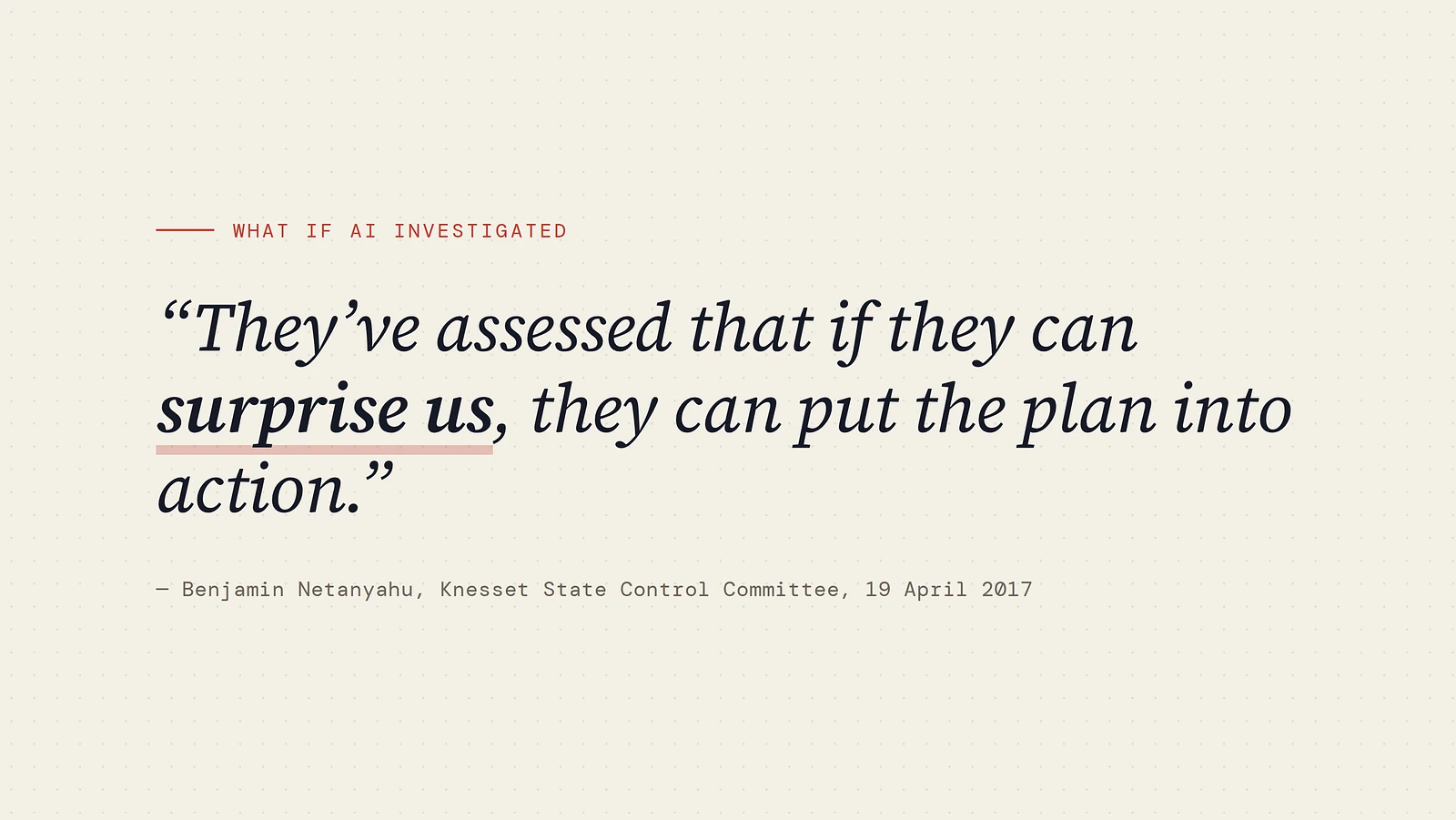
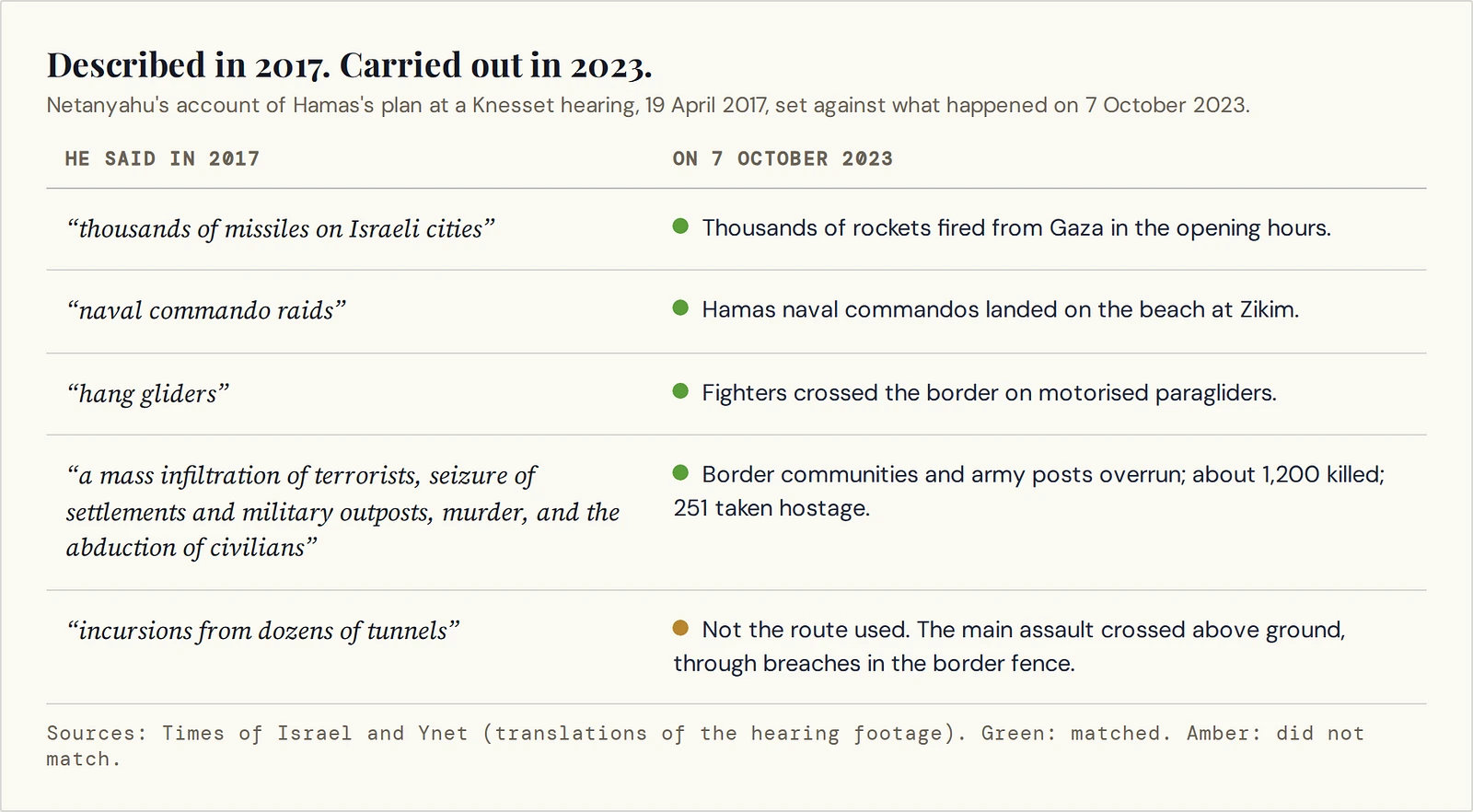
On 19 April 2017, at a Knesset State Control Committee hearing on the State Comptroller’s report into the 2014 Gaza war, he described it, in the Times of Israel’s translation of footage that Hebrew media aired in December 2023. “Hamas has an operational plan for a multi-pronged attack, including thousands of missiles on Israeli cities, naval commando raids, hang gliders and incursions from dozens of tunnels,” he said. “They’ve assessed that if they can surprise us, they can put the plan into action.” And: “At any given moment they could have put that plan into action, but contrary to popular opinion, we don’t control our opponent’s decisions — at most, we can influence their ability to carry them out.”
That February, the army had spent five days rehearsing essentially that scenario: mass infiltration of border communities by tunnel, paraglider and naval commando.
The hearing he was speaking at is itself part of the record. The comptroller had found that, despite being “well-versed in the tunnel threat” and knowing it had been defined as “a central and even strategic threat” by the end of 2013, Netanyahu had not had it presented to his security cabinet “in a clear and detailed manner” before the 2014 war. Before the report was published, officials close to the prime minister said the cabinet had been briefed on the tunnels in 13 meetings. The comptroller also faulted the defence minister, the chief of staff, military intelligence, the head of the Shin Bet, the head of the National Security Council and the operations chief.
So by 2017 the scenario was known, rehearsed and described from the prime minister’s own mouth. In the same hearing in which he described the attack, he said Hamas was deterred.
What Reached the Agencies, and What May Have Reached Him
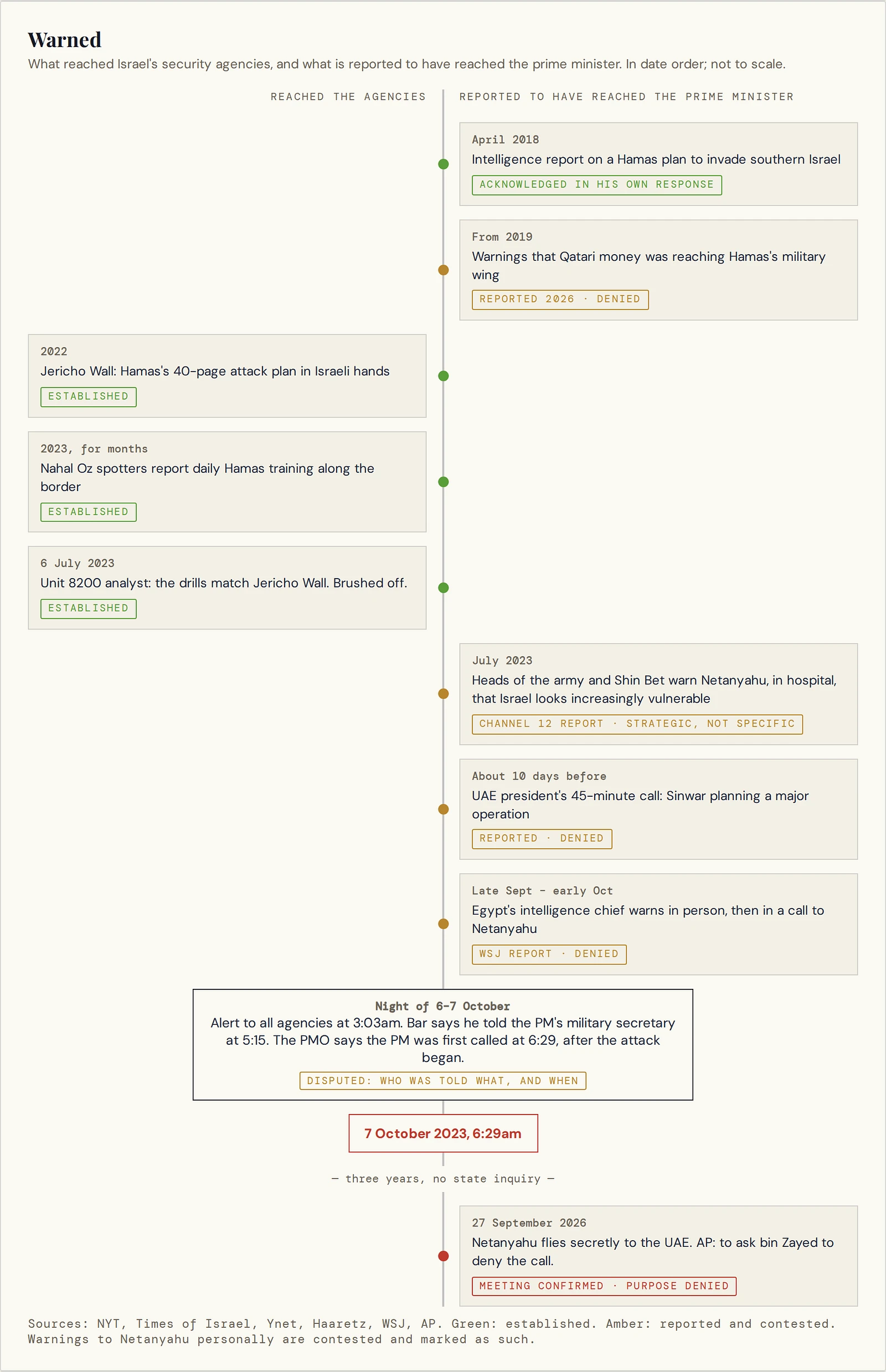
The agencies’ failures are set out in the companion piece and in Israel’s own investigations. In brief: the Hamas battle plan Israeli intelligence called Jericho Wall, about 40 pages, was in Israeli hands more than a year before the attack, and the attack followed it, the New York Times reported, “with shocking precision.” In July 2023 an analyst in Unit 8200 warned that Hamas was rehearsing it, and was brushed off by a colonel in the Gaza Division. “I utterly refute that the scenario is imaginary,” she wrote. The young women of the surveillance unit at Nahal Oz reported Hamas training, digging and laying explosives along the border for months. Their warnings went nowhere. The army’s own chief of staff later apologised to four of them, freed from captivity: “It was wrong to have not taken you seriously.”
The Times could not establish whether Jericho Wall ever reached Netanyahu personally. In February 2026, Israeli reporting said he had received intelligence on a Hamas plan to invade southern Israel as early as 2018. His office told the State Comptroller he was never briefed on Jericho Wall; his own 55-page response acknowledged receiving an April 2018 intelligence report but, according to the Times of Israel, quoted only its most restrained assessment. Whether the plan itself reached him remains contested.
What reached the agencies is documented; what reached him is disputed. What this piece is concerned with is what was aimed at him directly.
From his own security chief. Ronen Bar has said he warned Netanyahu repeatedly through 2023 that Israel’s deterrence was eroding. Channel 12 reported that in July 2023, while Netanyahu was recovering in hospital from a pacemaker operation, the heads of the army and the Shin Bet both warned him that Israel appeared increasingly vulnerable to attack, citing the strains over the judicial overhaul. Netanyahu’s office called the report “slander and lies.”
In early October 2026, Ynet reported that Bar had briefed a classified Knesset subcommittee in a presentation titled “The Perfect Storm”; according to several sources, lawmakers understood it to warn that internal divisions were eroding deterrence. Ynet’s sources put the briefing about three weeks before the attack; the proceedings are classified, and the timing is Ynet’s reporting, not Bar’s own account. Two cautions apply. First, Bar’s warnings were serious but strategic: they did not name a date, a place or an attack. Second, Netanyahu’s supporters argue that warnings issued in the shadow of the judicial overhaul were politically coloured and could be discounted. Both points belong on the page. So does a third: Netanyahu’s selectively released excerpts include material that cuts against Bar, and Bar says they omit his warnings and his offensive proposals. The full transcripts remain unpublished.
From Egypt. In 2023, the chair of the US House Foreign Affairs Committee said Egypt had warned Israel days before the attack. Israel’s national security adviser denied it. On 27 September 2026, the Wall Street Journal reported, citing officials in an Arab government (as relayed by the Times of Israel), that Egypt’s intelligence chief, Abbas Kamel, had warned Israel at least three times: twice earlier, the second in person on a visit to Israel in late September 2023, and then in a call to Netanyahu, or his office, days before the attack, with Egyptian warnings continuing until about 48 hours beforehand. The Atlantic reported that the visit took place on 26 September 2023; Netanyahu’s former national security adviser, Tzachi Hanegbi, has denied it. The officials said neither the Egyptian nor the Emirati warnings specified timing or scale. Netanyahu’s office says he did not meet or speak with Kamel in the months before 7 October, and that no Israeli intelligence source conveyed an Egyptian warning to him.
From the UAE. On 8 September 2026, Haaretz reported that Mohammed bin Zayed spent 45 minutes on the phone with Netanyahu about ten days before the attack, warning that Yahya Sinwar was planning a major operation. According to the report, Netanyahu replied that he believed Hamas intended to act in the West Bank, and, according to the report, did not brief the heads of the security establishment. The New York Times later confirmed the call from two sources and reported, citing five former senior officials, that the warning never reached the leaders of Israel’s security establishment. An Emirati source quoted by The National did not deny the call but said the UAE does not discuss such details at the level of national leaders.
Netanyahu denies receiving any warning from Egypt or the UAE. On 29 September, Likud announced that he had filed libel suits against Haaretz, Yedioth Ahronoth, Ynet and Channel 12 and six journalists and commentators, seeking at least NIS 2.6 million (Times of Israel). Whether these warnings reached him, and what they said, is contested. That is why the inquiry matters.
The Night Nobody Called
On the night of 6–7 October, Israel’s security agencies saw signs of unusual Hamas activity. In an affidavit to the High Court in April 2025, Bar wrote that at 3:03am all agencies were issued an alert about “unusual preparations and the possibility of offensive intentions by Hamas,” and that at 5:15am, “alongside various directives,” he instructed that the prime minister’s military secretary be updated (Times of Israel). Netanyahu’s office says the military secretary first called him at 6:29am, after the attack had begun, and that Bar’s 5:15am assessment document did not reach the military secretary until 9:47am (PMO timeline, via Ynet). In April 2025, the prime minister’s office said Bar’s chief of staff first contacted the military secretary at 6:13am, and sources in the office put the call at about 6:15am (Jerusalem Post).
Both accounts agree on one point: the prime minister was not called before the attack began. They disagree about whose failure that was. Netanyahu says Bar and the other security chiefs knew enough to wake him and chose not to, fearing he would order a mobilisation that might provoke Hamas. Bar says the failures that mattered came long before that night, in warnings the prime minister ignored. Both men hold documents the public has not seen, and, as Ynet notes, who was responsible for the gap between Bar’s 5:15am instruction and the 6:29am call remains one of the questions the public record does not fully answer.
How he treats a warning he believes
The question that matters is not whether Netanyahu ever acts on intelligence. He does, decisively.
On 30 April 2018 he personally unveiled, in a televised presentation, the nuclear archive the Mossad had taken out of Tehran. Eight days later, on 8 May, the United States left the Iran nuclear deal. In September 2024 came the pager operation against Hezbollah and the strike that killed Hassan Nasrallah; his office confirmed Netanyahu approved the pager operation. In November 2024, according to Israeli media reports of his remarks to the cabinet, he said both “were carried out despite the opposition of senior officials in the defence establishment and those responsible for them in the political echelon.” On his own account, when he believes a threat he will overrule senior officials to act on it.
And on Iran, he has believed the threat for a long time. “Within three to five years, we can assume that Iran will become autonomous in its ability to develop and produce a nuclear bomb,” he reportedly told the Knesset in 1992, according to Al Jazeera. The same reporting says he repeated the timeline in his 1995 book. In September 2012 he held up a cartoon bomb at the UN General Assembly and said that “by next spring, at most by next summer” Iran would finish the medium stage of enrichment and move on to the final stage (UN News). Weeks later, in a cable shared with South African intelligence on 22 October 2012 and leaked to Al Jazeera and the Guardian in 2015, the Mossad assessed that Iran was “not performing the activity necessary to produce weapons.” The same cable said Iran was working to close gaps that would shorten the time needed once an order was given, and a Times of Israel analysis argued the two assessments differed over speed, not substance.
In June 2025 he ordered strikes on Iran, saying that, “if not stopped, Iran could produce a nuclear weapon in a very short time.” Three months earlier, America’s director of national intelligence had told the Senate that the intelligence community “continues to assess that Iran is not building a nuclear weapon.” In June she said Iran could produce one within weeks to months if it decided to finalise assembly, and a source with access to US intelligence reports told Reuters the March assessment had not changed.
Set the two threats side by side. On Iran, when the assessments around him were less alarmed than he was, he went with the alarm. On Hamas, when he had described the attack himself, and, by reports he denies, allies were warning him, he went with the reassurance.
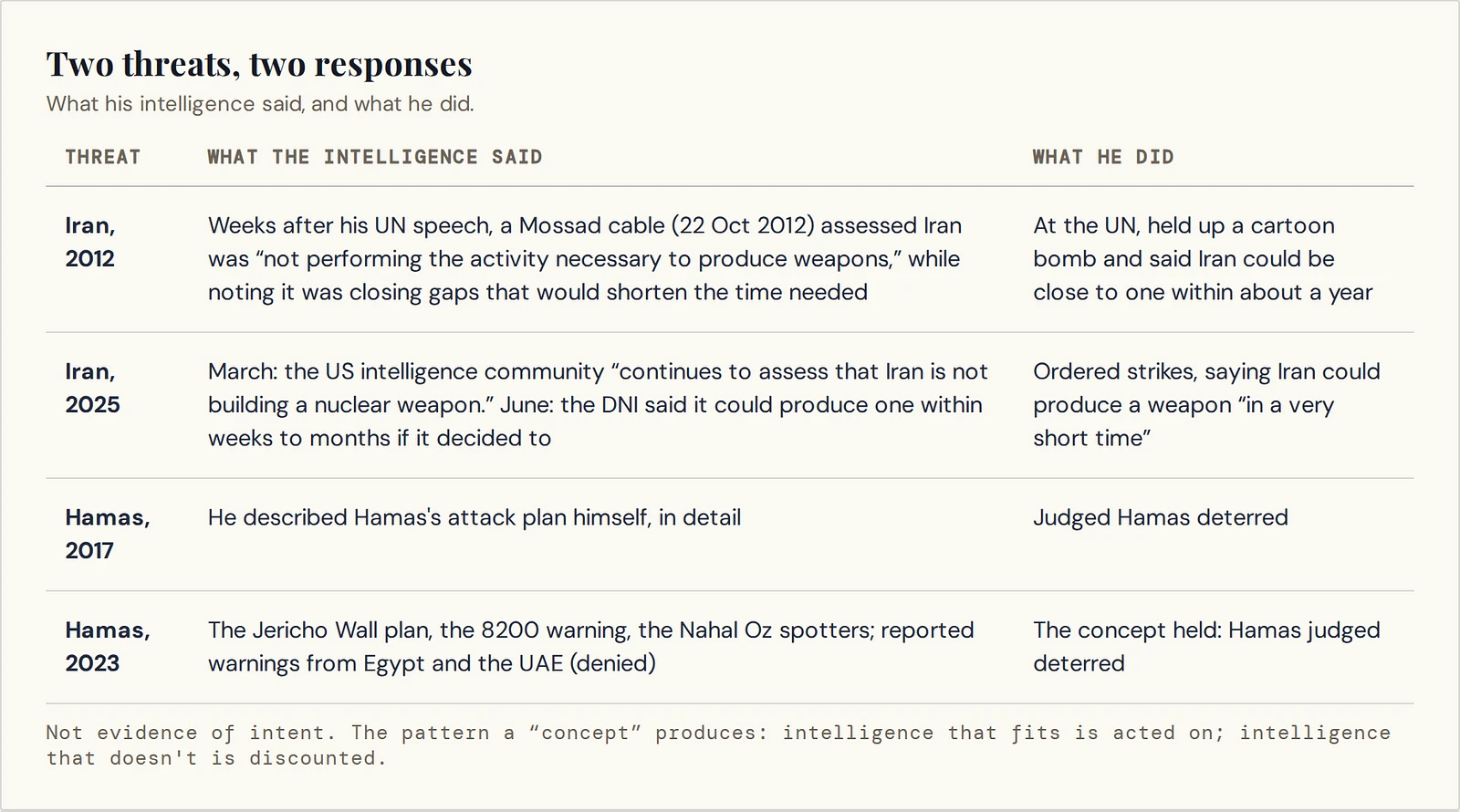
This is not evidence of intent. It is what a concept looks like from the outside: intelligence that fits the framework is acted on, even when it is contested; intelligence that contradicts it is discounted, even when it is specific. A 2025 study in the Journal of Strategic Studies, by Avner Barnea of the University of Haifa, put the origin of this one plainly. Unlike 1973, it found, the conception before 7 October “was created for political reasons and only later integrated into the security system,” and “was supported and even was an initiative of the senior political echelon.” A civilian board of inquiry, convened outside the government, reached a similar view, finding Netanyahu largely responsible for the “money for quiet” concept and for silencing those who criticised it.
Netanyahu’s own account points the other way. In a 55-page response to the State Comptroller, he argued that he repeatedly pushed to kill Hamas’s leaders and that his security chiefs argued against it, quoting selected passages from cabinet protocols. Opposition members asked to see the full versions. They have not been released.
Among the Best Intelligence Services in the World, and It Missed It
There is an obvious objection. Israel has some of the most capable intelligence services in the world, and they missed it too. Doesn’t that make this an institutional failure rather than a political one?
Part of the answer is that the reputation is narrower than it looks: it rests on what Israeli intelligence can find, and the failure was in what it would hear. Israeli intelligence is among the best in the world at penetration and targeting: finding people, getting into archives, booby-trapping pagers. That is what the public sees. It is far weaker at strategic warning, the job of telling a government that an enemy is about to do something it has convinced itself the enemy won’t do. Barnea’s study found that from 1960 to 2023, Israeli intelligence raised a warning before a strategic surprise only once. In the best known case, 1973, the historian Uri Bar-Joseph has argued that military intelligence’s adherence to the “concept” led it to misread the warnings it did receive.
The weaknesses before 7 October are documented. The open-source intelligence unit, Hatzav, was dismantled in December 2021. In 2022 Hamas broadcast a Ramadan TV series, Fist of the Free, and staged highly publicised exercises that, in the analyst Michael Milshtein’s words, depicted “scenarios resembling the eventual attack”. (The series was built around a botched 2018 Israeli raid in Gaza, though its scenes of fighters overrunning an Israeli tank were later compared to 7 October.) A senior Hamas military figure captured during the war was quoted in an Israeli interrogation, Milshtein reports, as saying: “The problem was not that you failed to decipher Sinwar. You simply did not listen to him, because he said explicitly and publicly that he intended to advance a ‘world war’ against you.” When the possibility of a Hamas attack was raised with the head of military intelligence, his reported reply was: “Let them come.” The scholar Uri Bar-Joseph, one of Israel’s leading authorities on the 1973 failure, is quoted by Milshtein as describing the result as “intolerable conformity at the top of the military.”
The core of this is documented. The question this piece raises is narrower: where the conformity began. The agencies’ own investigations have been published, in part. As of October 2026, the political level has not been examined by anyone with the power to compel evidence.
What the Army Did That Morning
When the attack came, the response is documented in our earlier pieces, The Hannibal Directive and October 7 and The Attack Proceeds. In brief: Haaretz reported in July 2024 that the army invoked the Hannibal procedure that morning. At 7:18am: “Hannibal at Erez… dispatch a Zik,” an attack drone. At 11:22am, an order to the Gaza Division: “Not a single vehicle can return to Gaza.” A Southern Command source told the paper: “Everyone knew by then that such vehicles could be carrying kidnapped civilians or soldiers.” The same source added: “There was no case in which a vehicle carrying kidnapped people was knowingly attacked, but you couldn’t really know if there were any such people in a vehicle. I can’t say there was a clear instruction, but everyone knew what it meant to not let any vehicles return to Gaza.”
In a 6 February 2025 Channel 12 interview, Yoav Gallant, by then dismissed as defence minister, appeared to acknowledge that the Hannibal directive was applied: “tactically, in some places, it was given, and in other places, it was not given, and that is a problem.” That wording comes from a subtitled clip of the broadcast; mainstream Israeli outlets did not report the exchange.
At Kibbutz Be’eri, Hamas gunmen held 14 or 15 people (accounts differ) at Pessi Cohen’s house. Brigadier General Barak Hiram, commanding the 99th Division, ordered a tank to fire at it, and the IDF’s July 2024 probe found his order “reasonable in view of the conditions.” Briefing journalists, the army’s spokesman said that hostages outside the building were hit by tank shrapnel and that it was “highly likely” one of them was killed as a result. That was Adi Dagan, 68, who was being held in the yard; his wife Hadas, 70, was wounded. Only two hostages survived: Hadas Dagan and Yasmin Porat.
The probe concluded that “most of the hostages inside the house were murdered by the terrorists,” on “the information examined so far”; some survivors and residents dispute it. According to the probe as reported by the Times of Israel, a tank fired four light shells between 17:33 and 18:57. The third, at 18:34, was aimed at the path, bounced and struck above the doorway; its shrapnel killed Adi Dagan. Some early reports, which counted only the shots aimed at the house, spoke of two.
What the army ordered that morning is documented; what the orders cost is not. How many Israelis were killed by Israeli fire that day is unresolved. Haaretz says it does not know. A UN commission concluded that Israeli forces had likely applied the Hannibal Directive in several places. Its summary puts the number of Israeli civilians killed at “at least 14”; its detailed text says “up to 14” in two further cases it verified. Israel has not published a comprehensive account of how many were killed by Israeli fire.
The inquiry that hasn’t happened
After the 1973 war, Israel set up a state commission of inquiry, the Agranat Commission, within 46 days; three years after 7 October, it has set up none. Its interim report recommended dismissing the chief of staff and the head of military intelligence, but declined to judge the political leadership. Public anger at that omission helped bring down Prime Minister Golda Meir, who announced her resignation within ten days.
After 7 October, three years on, there is none. The reasons given have shifted: not during the war; not until victory on every front; not under a judge appointed panel the government calls biased. In late April 2026 the High Court gave the government two months to decide on an inquiry, stopping short of ordering a state commission. On 22 July the government told the court that its own inquiry legislation, for a politically appointed panel, had been delayed by Knesset scheduling constraints, and urged it not to intervene. On 23 September the court itself deferred any ruling until after the 27 October election, appearing to accept the Attorney General’s view that the decision belongs to the next government, and gave the government until 15 January 2027 to update its position. Polls have repeatedly shown a majority of Israelis want a state commission. Gadi Eisenkot, whose Yashar party leads most polls though the blocs are roughly tied, has promised one if elected.
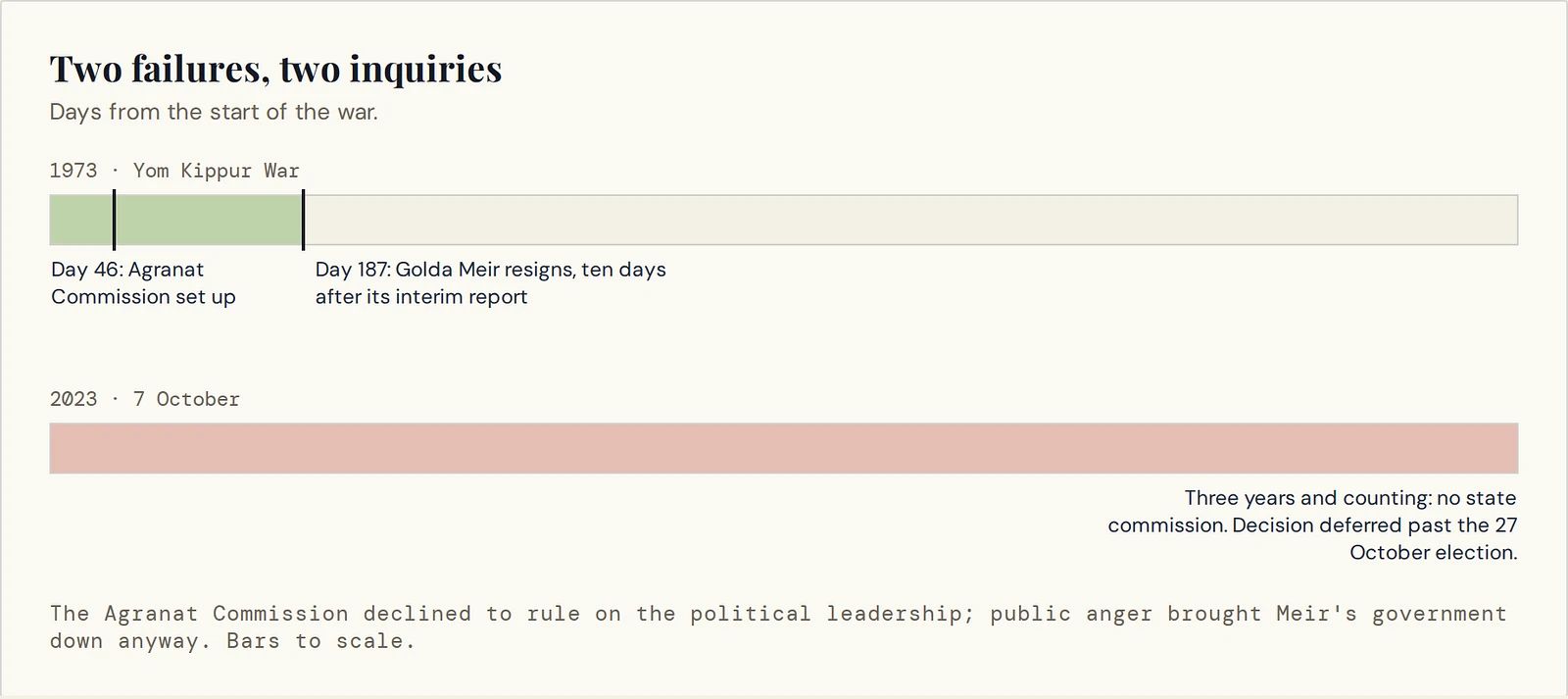
In its place the country has the agencies’ internal reviews, which did not examine the political level, and a prime minister who, Bar charges, is releasing only selected excerpts from the protocols that would.
The Israeli analyst Michael Milshtein calls the absence of a state commission “the central institutional failure” since 7 October. Without one, he wrote in September, Israel “risks repeating assumptions before they are even recognised as assumptions.” On 6 October 2023, in a weekend supplement published on the eve of the attack, a former head of military intelligence, Aharon Ze’evi-Farkash, wrote about the 1973 war that unless Israel investigated its failures, “we will be surprised again and caught unprepared,” as Milshtein quotes him. The next morning, at 6:29, he was proved right.
What the record establishes
Three readings
There are three ways to read what happened at the political level, and the evidence does not weigh them equally.
He did not believe the warnings. Netanyahu was a prisoner of the concept, as most of Israel’s security establishment was: wrong, catastrophically, but in good faith. This is the reading his defenders offer, and parts of the record support it. The agencies were wrong too. Strategic surprise is common. The Egyptian and Emirati warnings, as reported, did not specify timing or scale.
He believed them and chose not to act. He weighed the warnings against the policy, and the policy won. This reading is contested. It rests on warnings he denies receiving, and on a pattern of behaviour, not a document.
He wanted it to happen. There is no public evidence for this, and we do not advance it.
If the first reading is right, it still has to account for a few things. A prime minister who described the attack himself, in detail, six years before it happened. A man who acted on a faster Iran timeline than public assessments supported, but stayed with the reassurance about Hamas. Warnings from his own security chief, and reportedly from Egypt’s intelligence chief and the UAE’s president, that never reached the people responsible for the border. And, three years later, a secret flight to Abu Dhabi where, according to AP’s source, he asked the UAE’s president to deny a phone call, an inquiry deferred past an election, and protocols released only in the parts he chooses, as Bar and opposition members charge.
None of that proves the second reading. All of it is what an independent inquiry would exist to test. That none has been set up, three years on, is the last fact in the record.