The army’s verdict
On 15 October 2026, the Israel Defense Forces published a three-slide post on its verified Facebook page. Its caption reads:[1]
The first slide promises “a letter that reveals more than just a child’s words.” The second shows a handwritten page in Arabic with an English translation underneath. The third gives the verdict:
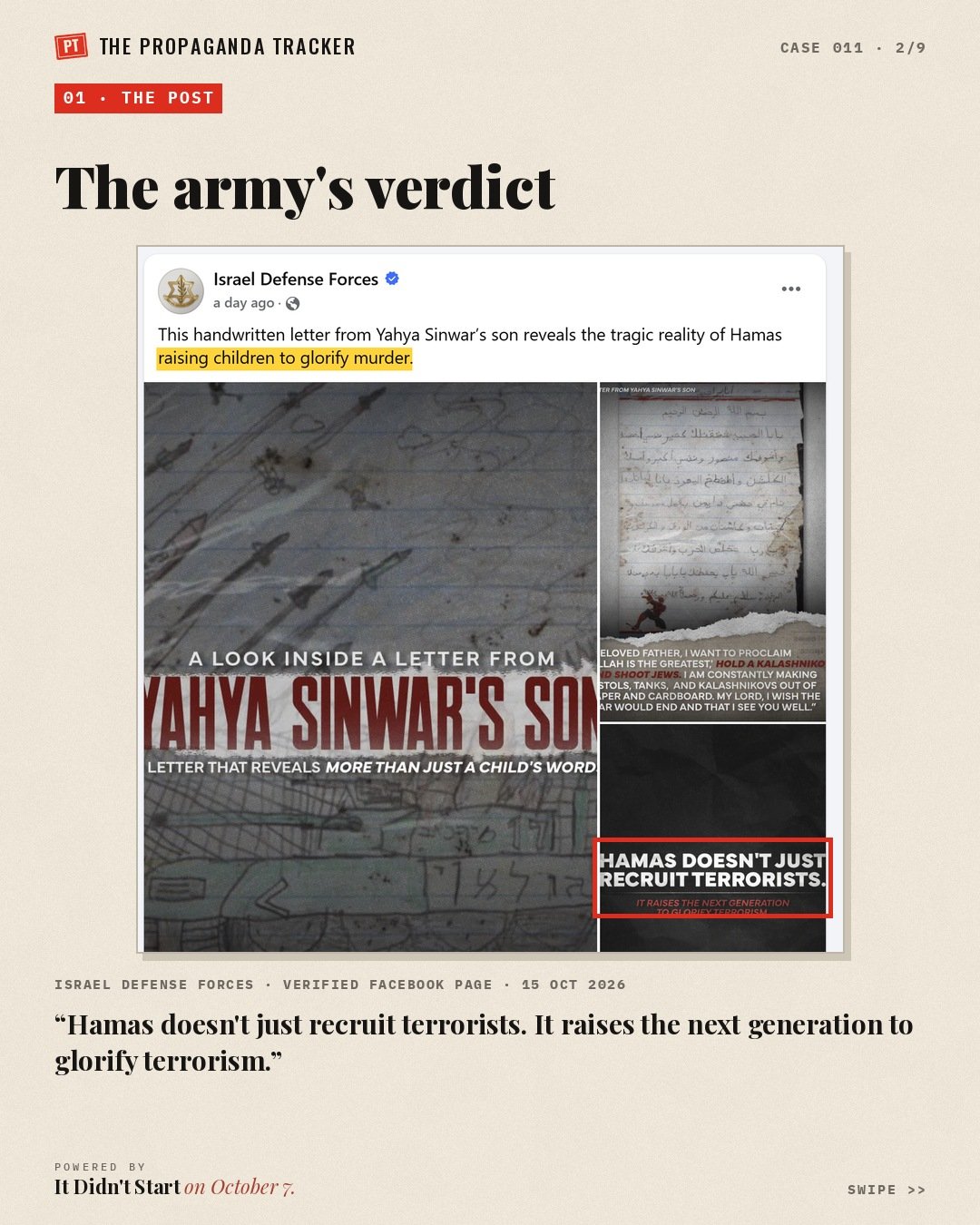
The post makes three claims at once: that the letter is what the army says it is; that the translation is faithful; and that one letter tells us how a whole generation is being raised. We checked each in turn.
Who says the letter is real?
The question: Where does the letter come from, and has anyone besides the publisher confirmed it?
What we found: Every report traces back to one source, the army. The Times of Israel, reporting the release the same evening, attributes each detail to the military: the IDF “publishes a letter it says was written by the terror chief’s son, Ibrahim, at the start of the Gaza war, when he was 10 years old,” and “the army says the letter had been recovered by soldiers operating in the Strip in 2024.”[2] i24NEWS reports the same: the letter “was seized in 2024 by IDF troops in the Gaza Strip.”[3]
No outlet gives a place, a date of recovery, or a description of how the army established who wrote it. No independent body has examined the document.
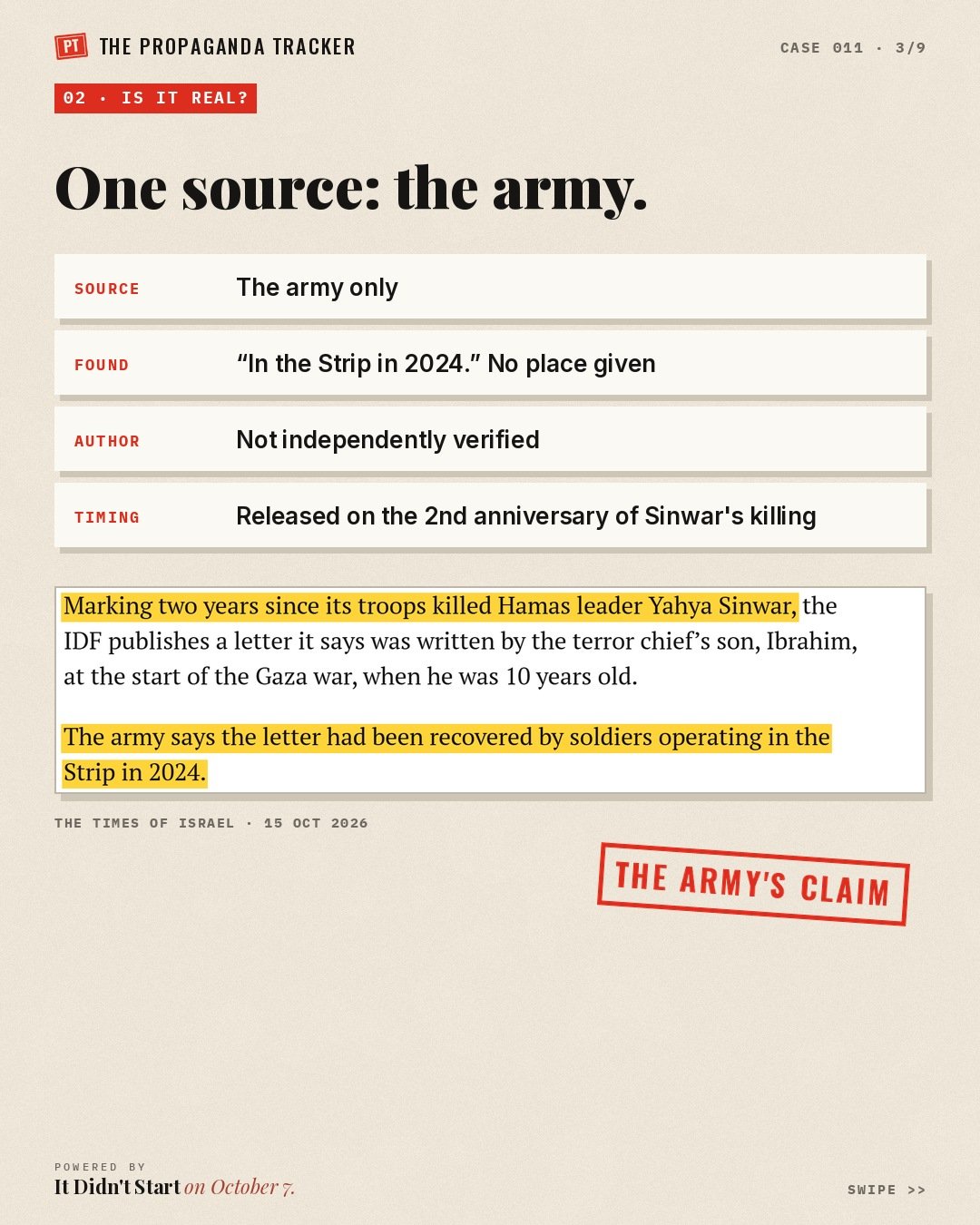
The Times of Israel also notes the timing: the army released the letter “marking two years since its troops killed Hamas leader Yahya Sinwar.”[2]
What does the letter actually say?
The question: Before comparing translations, what is written on the page?
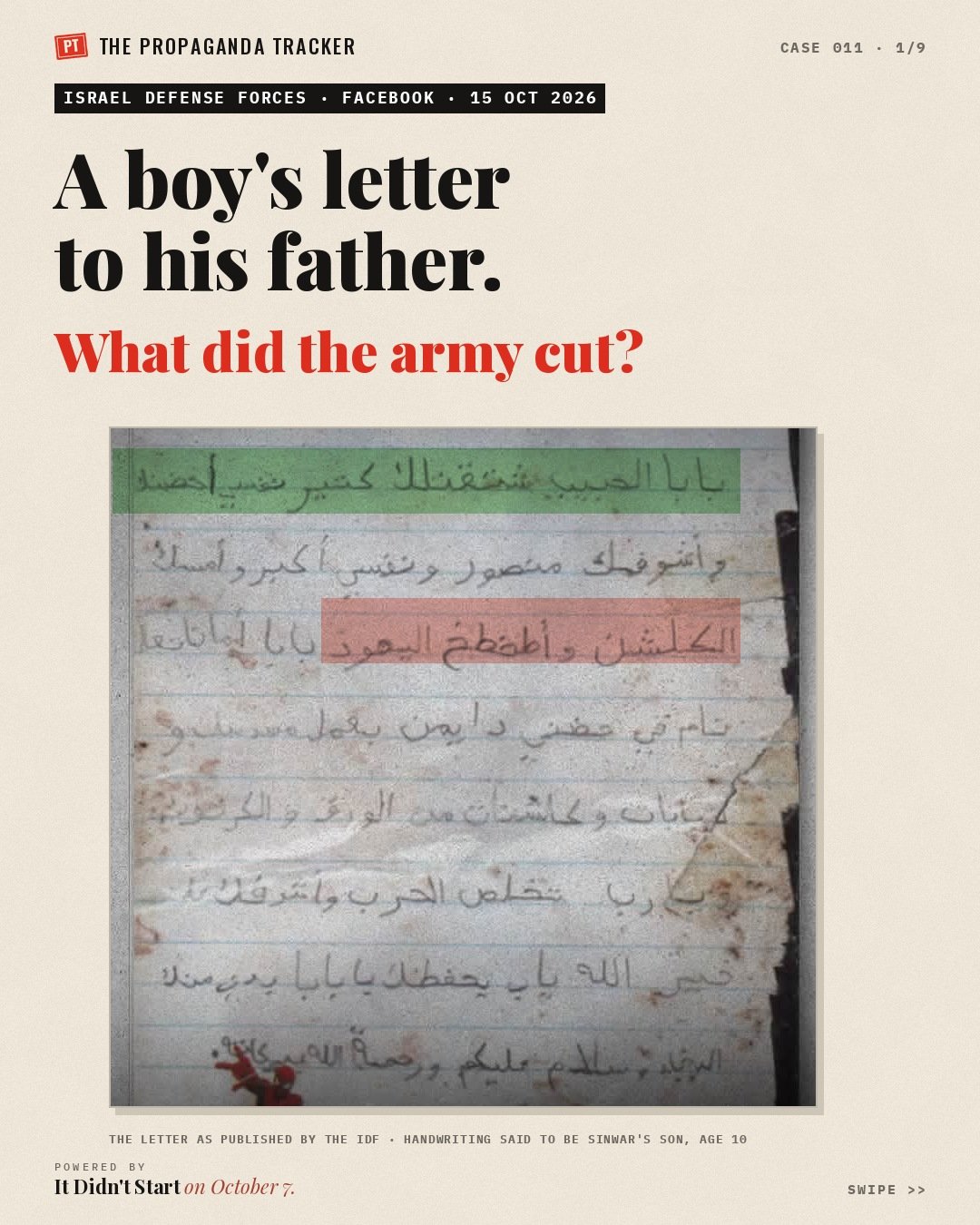
What we did: We transcribed the legible lines from the image the army itself published, and had our reading of the key line confirmed by a native Arabic speaker. The opening reads:
وأشوفك منصور ونفسي أكبر وأمسك
الكلاشن وأطخطخ اليهود
In English:
Later lines say the boy makes pistols, tanks and Kalashnikovs out of paper and cardboard, ask God that the war end so he can see his father, and ask God to protect him.
The shooting line is in the letter. We do not soften it and we do not hide it. A child wrote it. The question this fact-check asks is narrower: did the army show the public what the child wrote?
Two versions from the same army
The question: Does the army’s public graphic match the army’s own translation?
What we found: It does not. The military gave the Times of Israel a translation. That translation, quoted in full by the paper, reads:[2]
And later:
The graphic the army posted on Facebook reads:
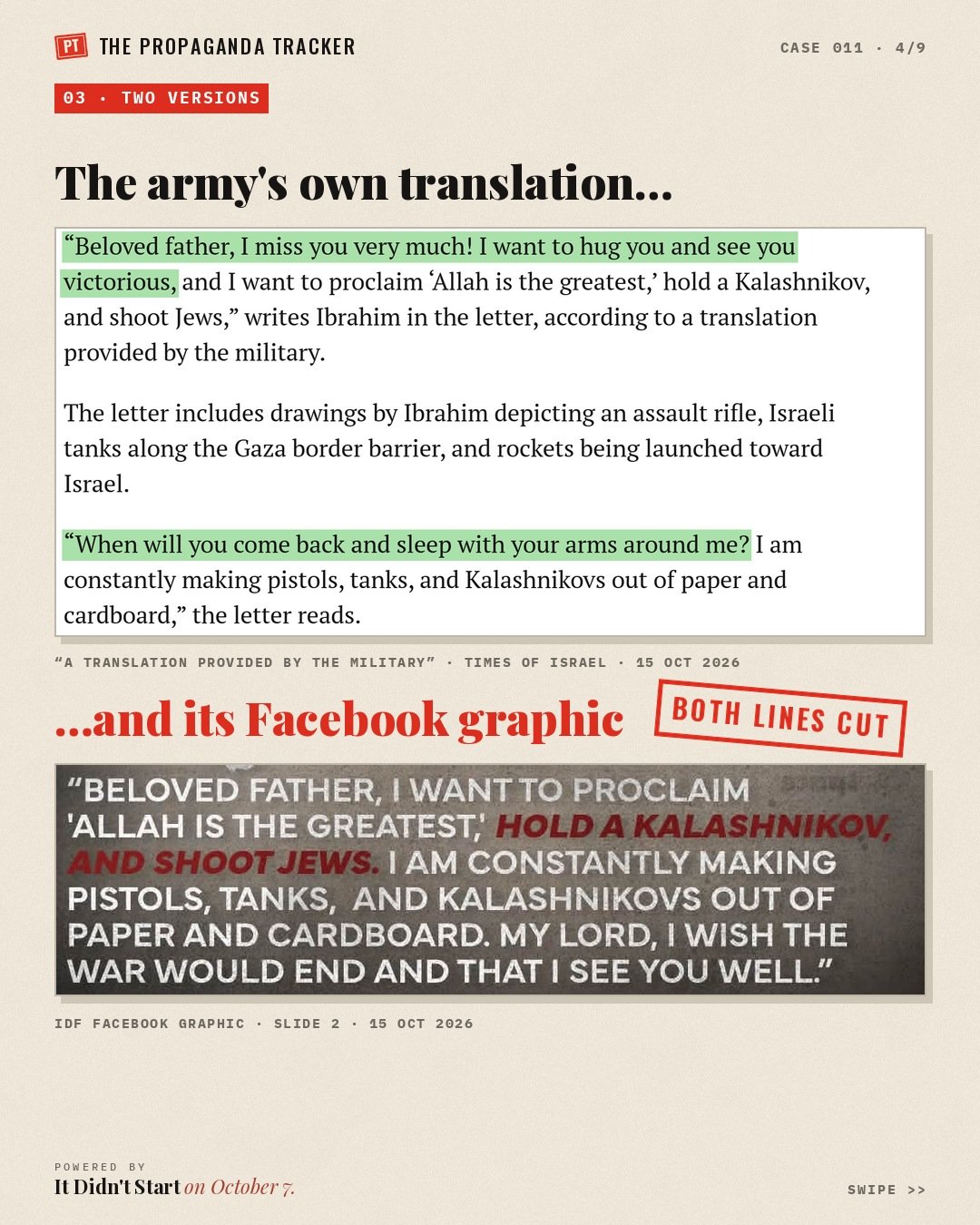
Set side by side, the graphic removes two passages from the army’s own translation:
- “I miss you very much! I want to hug you and see you victorious”
- “When will you come back and sleep with your arms around me?”
The omission is not ours to infer from a rival source. It sits inside the army’s own material. A second outlet, i24NEWS, also reported that in the letter “Ibrahim expresses how much he misses him,” which confirms the longing was part of the text that circulated with the release.[3]
To be fair to the graphic: it keeps one gentle line, “My Lord, I wish the war would end and that I see you well.” What it removes are the lines that show a child missing his father’s embrace.
One word, two meanings
The question: Is “I want to proclaim ‘Allah is the greatest’” a fair translation?
What we found: No. The phrase in the letter is نفسي أكبر, everyday spoken Arabic for “I wish to grow up” or “I wish I were older.” The word أكبر (akbar) means “bigger” or “older.” The religious phrase “Allah is the greatest” is الله أكبر, and it requires the word الله (Allah). That word does not appear in the sentence.
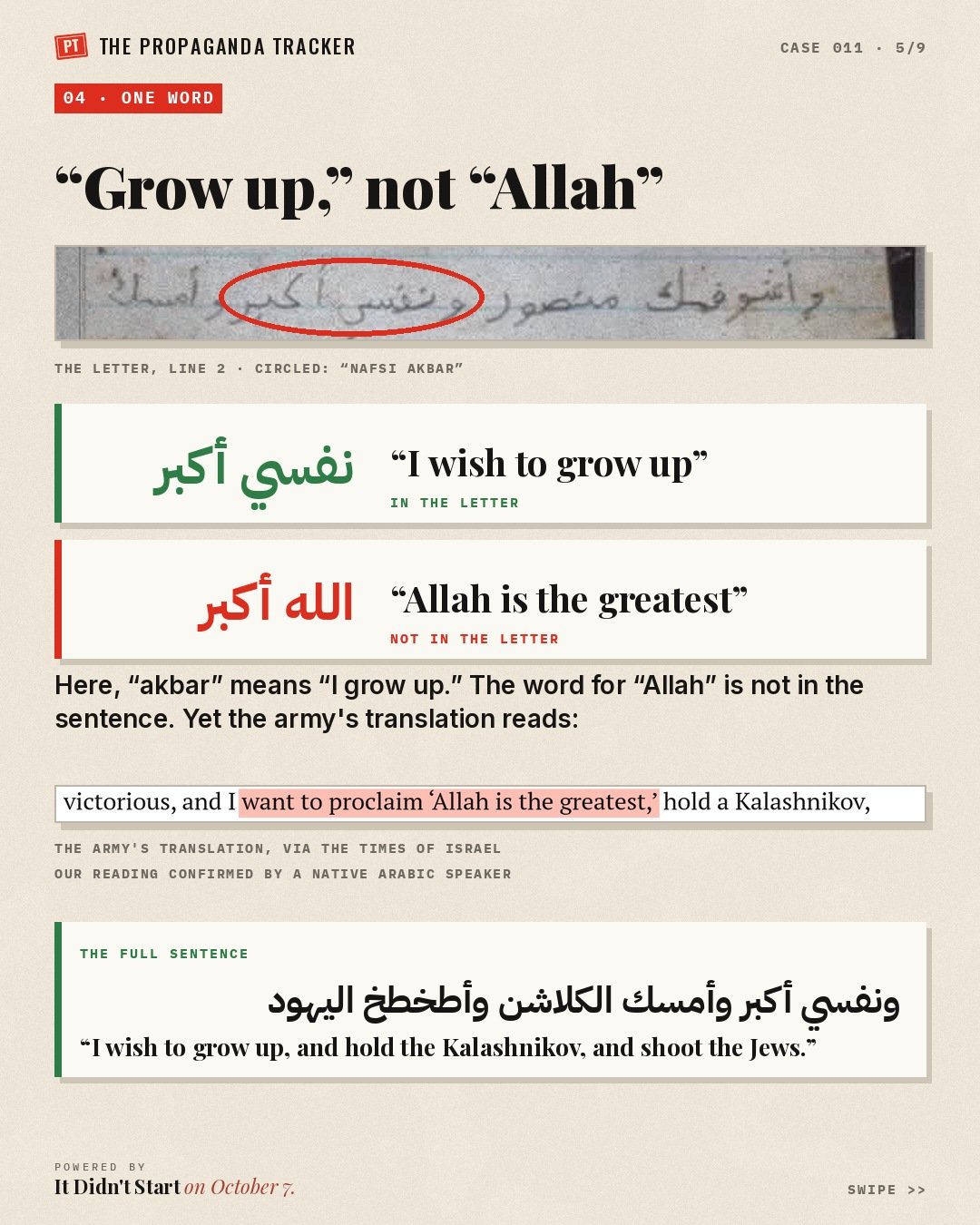
To reach “I want to proclaim ‘Allah is the greatest,’” a translator has to add a verb (“proclaim”) and a word (“Allah”) that are not on the page. This change appears in both the army’s full translation and its graphic.[1][2]
Mistake or choice?
We cannot know who translated the letter, how the graphic was edited, or why. Claiming intent without evidence would break our own rule: state only what can be proven.
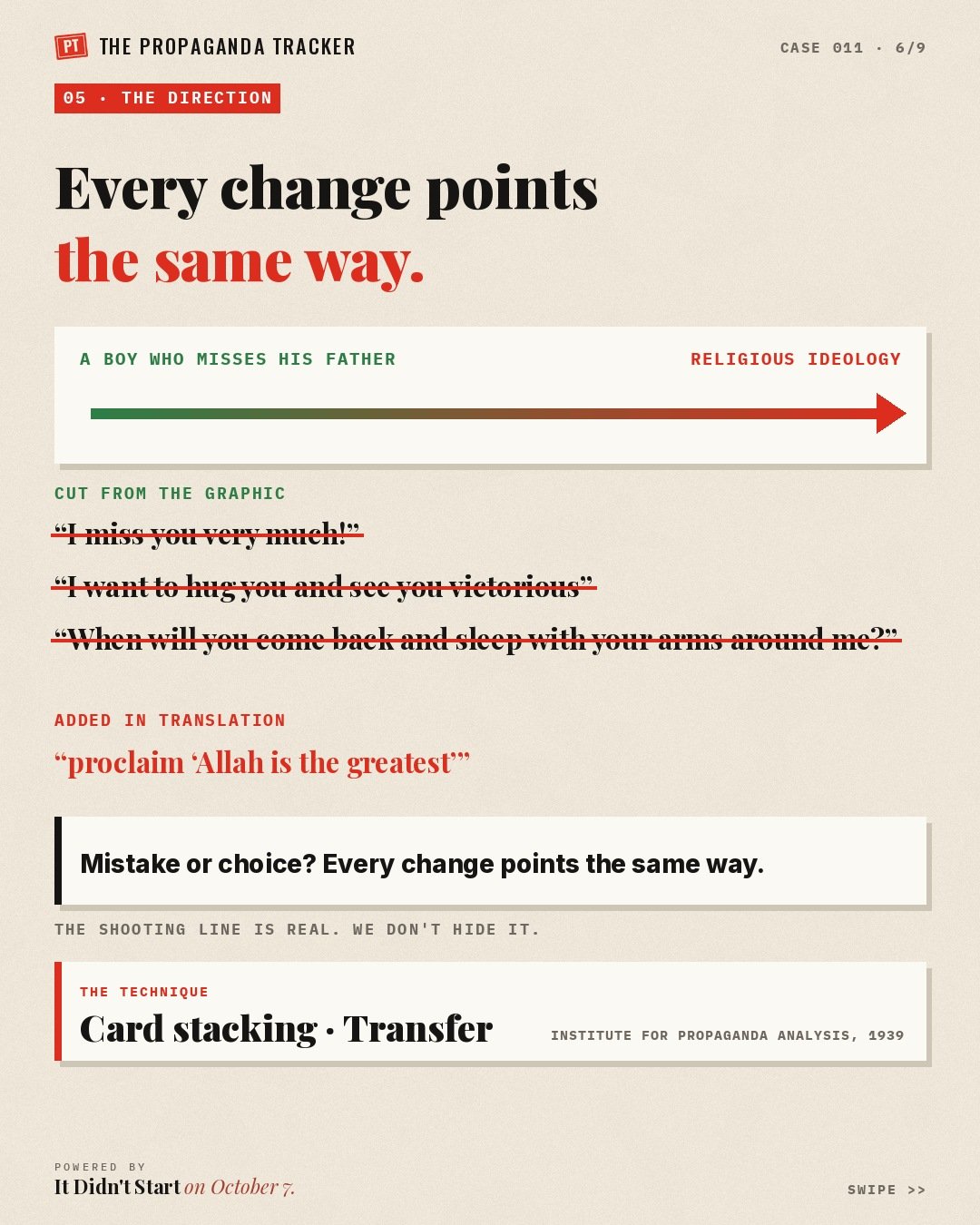
What we can show is the direction of the changes:
- Removed: “I miss you very much,” “I want to hug you,” “When will you come back and sleep with your arms around me?”
- Added: “proclaim ‘Allah is the greatest.’”
Random errors scatter. These do not. Every change moves the letter away from a boy who misses his father, and toward religious ideology. In Western media, the phrase “Allahu akbar” is heavily associated with images of terrorism; inserting it attaches that association to a child’s letter.
From one child to “the next generation”
The question: Can one letter support a claim about how Hamas raises “the next generation”?
What we found: The post moves from one document, written by one child, the son of one Hamas leader, to a statement about a generation. It offers no other evidence for the wider claim.[1]
The sociologist Nadera Shalhoub-Kevorkian describes this pattern in Incarcerated Childhood and the Politics of Unchilding (Cambridge University Press, 2019). Her concept of “unchilding” names the political work that seeks to “construct colonized children as dangerous, racialized others, enabling their eviction from the realm of childhood itself.”[5]
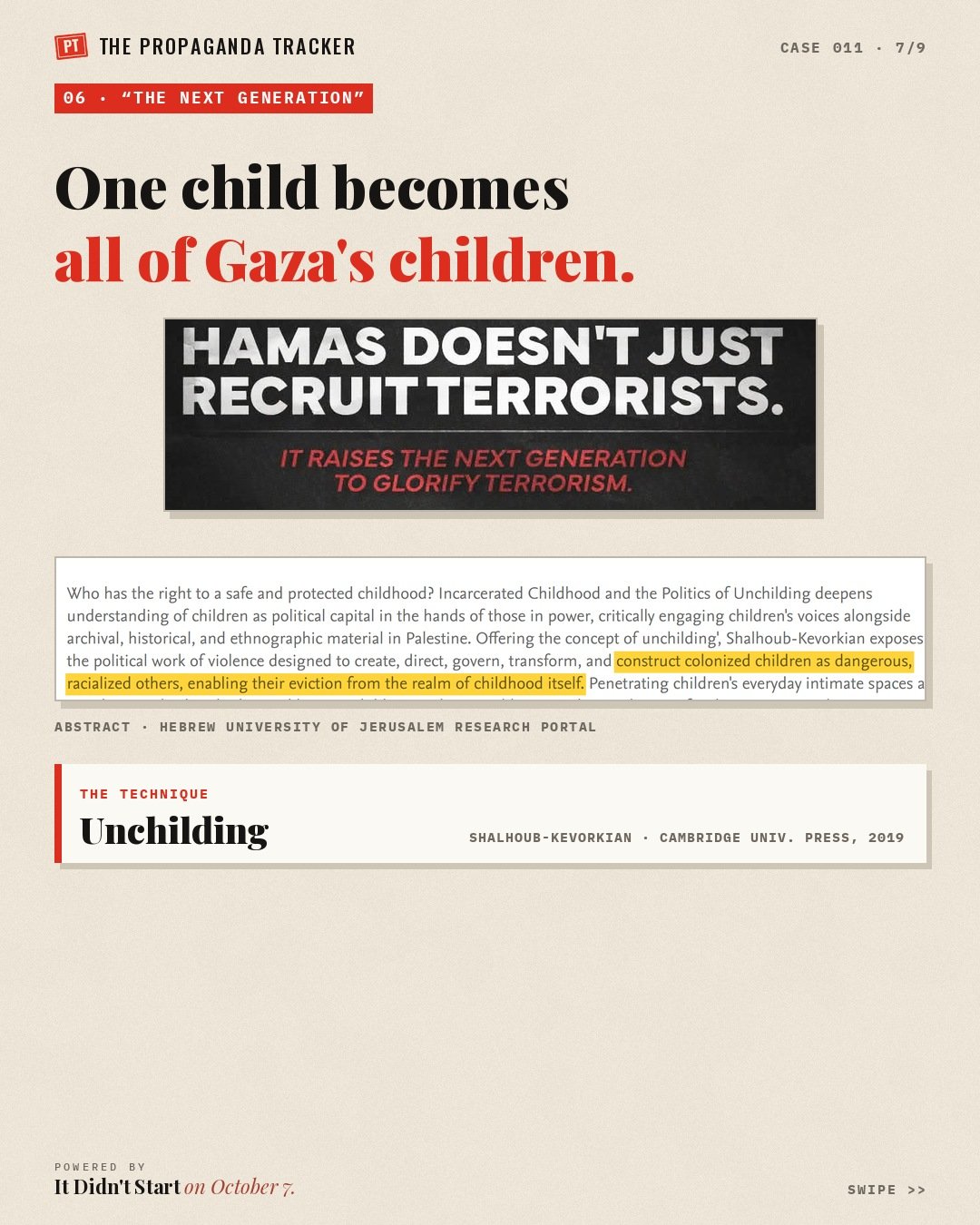
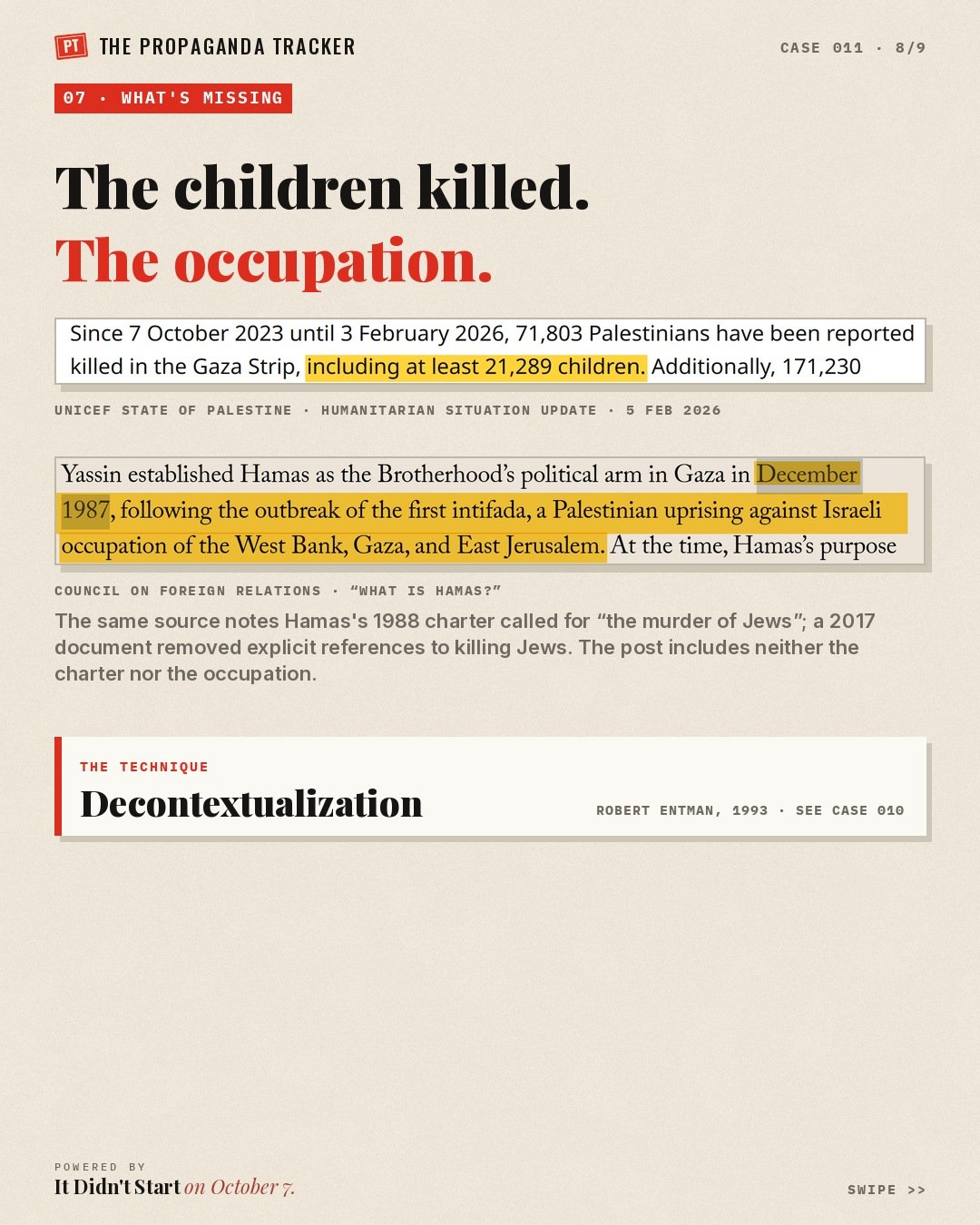
That framing matters in a war in which children are among the dead in large numbers. UNICEF reports that from 7 October 2023 to 3 February 2026, “71,803 Palestinians have been reported killed in the Gaza Strip, including at least 21,289 children.”[4]
When children are presented as future fighters, their deaths become easier to accept. The post does not say that. It does not need to.
What the post leaves out
The question: What context would change how a reader understands the post?
What we found: The post presents Hamas as an organization that exists to raise killers, and the letter as proof. It says nothing about the conditions in which this child, or any child in Gaza, was living when he wrote it: a war, a father he could not see, and the occupation that preceded both.
According to the Council on Foreign Relations, Sheikh Ahmed Yassin “established Hamas as the Brotherhood’s political arm in Gaza in December 1987, following the outbreak of the first intifada, a Palestinian uprising against Israeli occupation of the West Bank, Gaza, and East Jerusalem.”[6]
The same source records what critics of Hamas will rightly raise: the group “published its charter in 1988, calling for the murder of Jews, the destruction of Israel,” and in 2017 “presented a new document that removed explicit references to killing Jews but still refused to recognize Israel.”[6] We include it because a fact-check that hides inconvenient facts is not a fact-check.
The post includes neither the occupation nor the history. It offers a child’s letter in place of both.
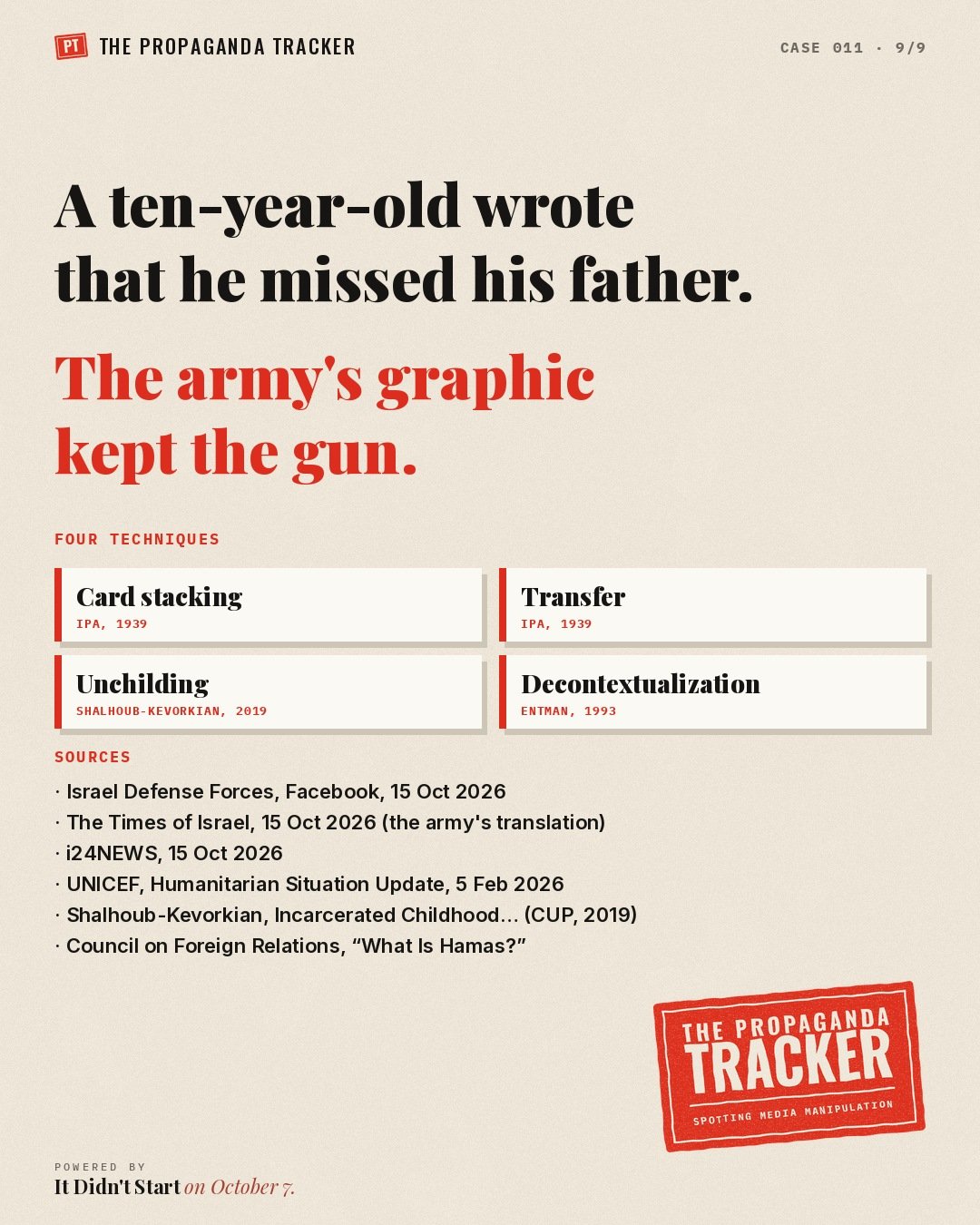
Four techniques in one post
Card stacking (Institute for Propaganda Analysis, 1939): choosing only the facts that build a case. The graphic keeps the gun and drops the hug.[7]
Transfer (Institute for Propaganda Analysis, 1939): carrying the feeling attached to one symbol over to something else. Inserting “Allah is the greatest” transfers the associations of that phrase onto a child’s letter.[7]
Unchilding (Nadera Shalhoub-Kevorkian, 2019): constructing children as dangerous, so that they are evicted from childhood itself. One child’s letter becomes “the next generation.”[5]
Decontextualization: reporting an event without the context that would change its meaning. The war, the absent father and the occupation are all missing.[8]
- Who wrote the letter, when, and where it was found. These rest on the army’s statement alone.
- Who produced the English translation and the graphic, and why they differ.
- The exact wording of some lower lines of the letter, which are partly illegible in the published image. Our findings rely only on lines we could read clearly and have confirmed with a native Arabic speaker.
How we checked
- We captured the original post, its caption and all three slides.
- We traced every report of the letter back to its source.
- We transcribed the Arabic from the army’s own image and had the key line confirmed by a native speaker.
- We compared three English versions: the army’s translation quoted by the Times of Israel, the army’s Facebook graphic, and i24NEWS’s report.
- We checked the wider claims against UNICEF, the Council on Foreign Relations and peer-reviewed scholarship.
- Every quotation in this piece was checked against a screenshot of its source.
The Propaganda Tracker: spotting media manipulation. This case was first published as Case 011 of The Propaganda Tracker. To document is to resist erasure.
Techniques in the Propaganda Technique Database: Transfer, Decontextualization.
Previous case: Does Ms Rachel Spread Hate? (Case 010). All articles: Propaganda Literacy.
See how we verify claims on this site.