One page, four posts, eleven days
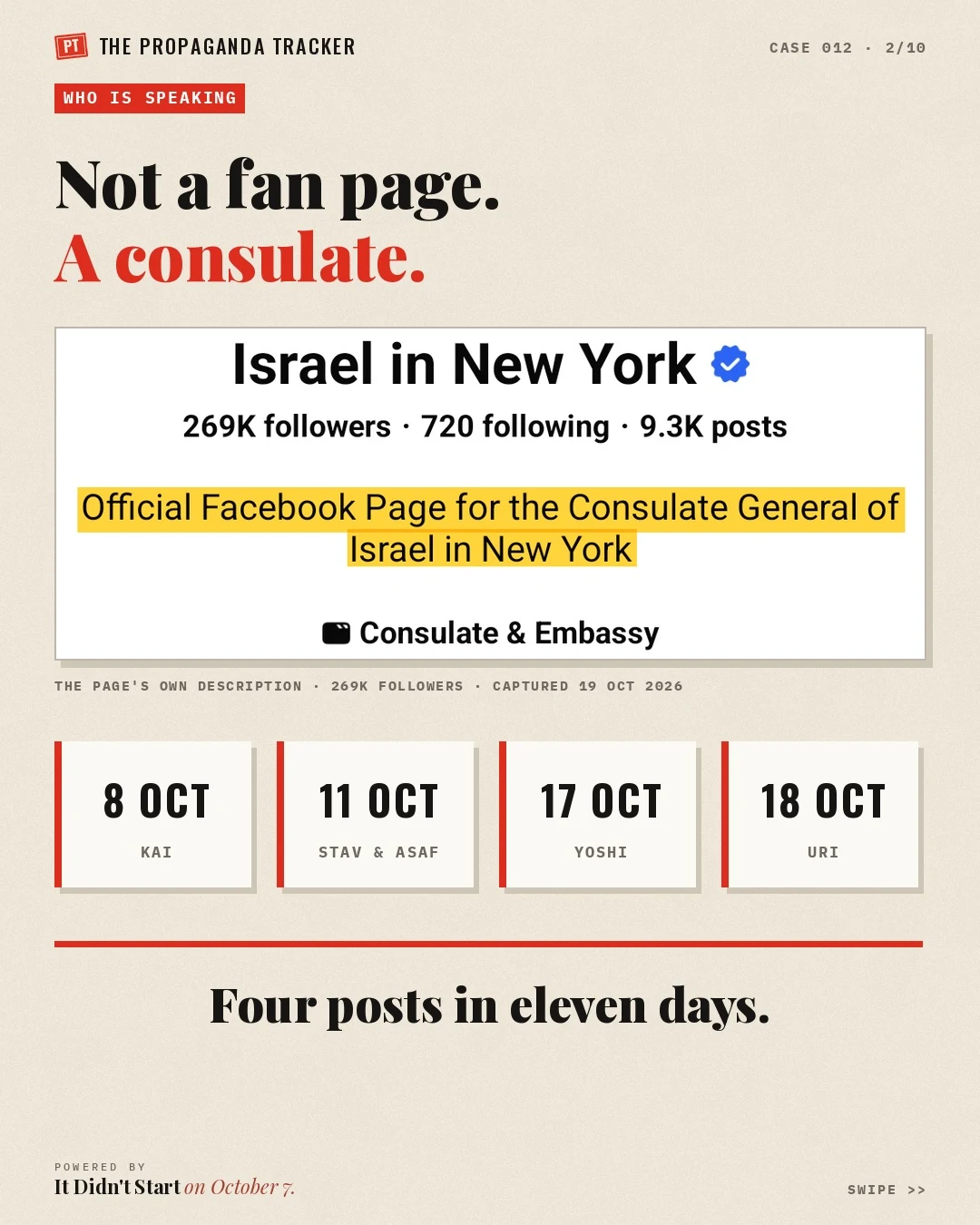
Israel in New York is a verified Facebook page with 269,000 followers. Its own description reads: “Official Facebook Page for the Consulate General of Israel in New York.”[1] That makes these posts the messaging of an Israeli consulate, a state account, not the opinions of a private user.
Between 8 and 18 October 2026, the page published four posts:[2]
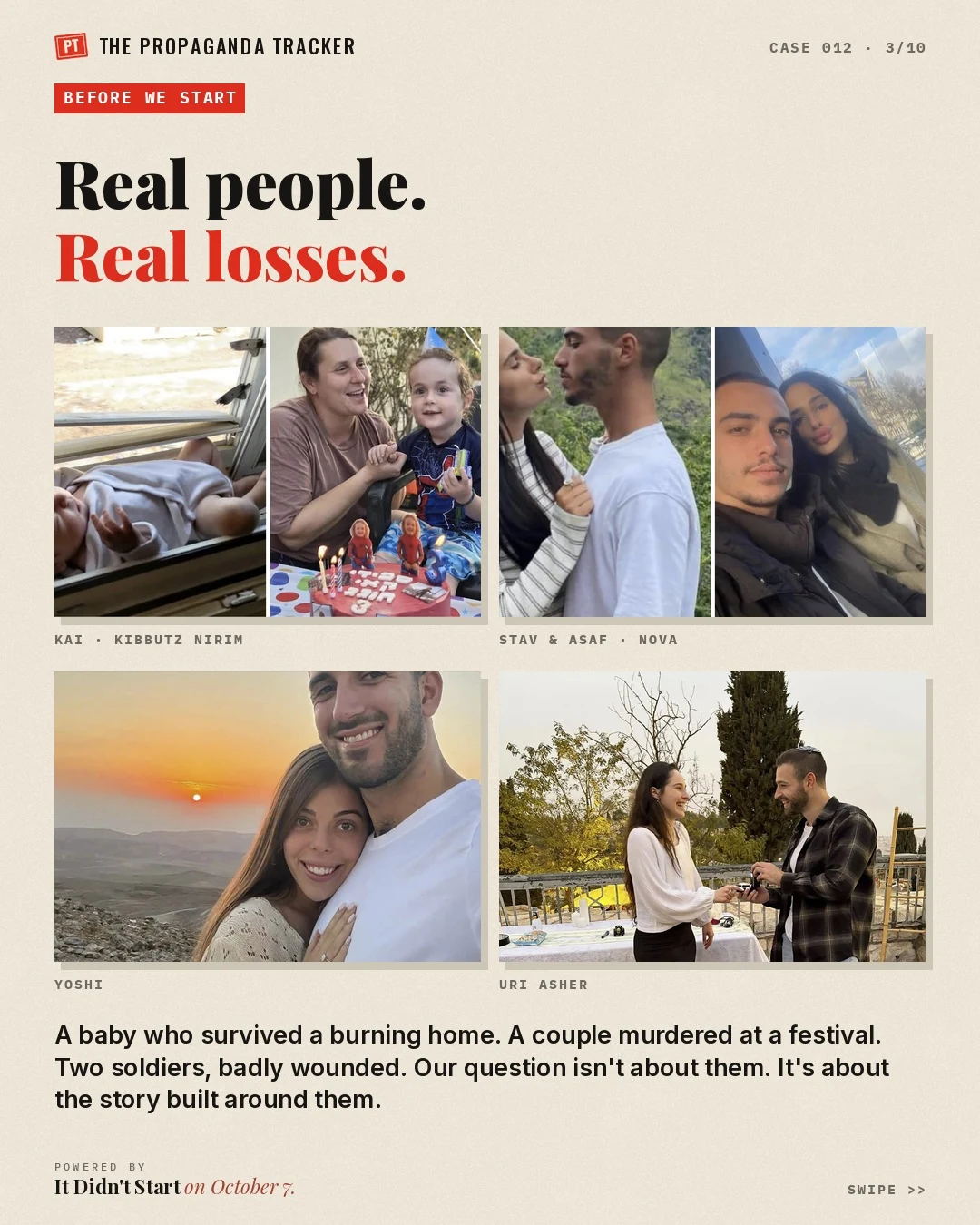
- 8 October: Kai Labban, 10 days old when Hamas attackers “stormed Kibbutz Nirim on October 7 and set his home on fire.” His parents placed him on the windowsill so he could breathe.
- 11 October: Stav Barazani, 22, and Asaf Edberg, 23, who fled the Nova Music Festival together. “Hamas terrorists murdered them side by side.”
- 17 October: Yoshi, “critically injured while defending Israel against Hezbollah terrorists in Lebanon,” now engaged.
- 18 October: Uri Asher, who lost his leg after “terrorists fired an anti-tank missile at Uri and his comrades while they were defending Israel,” now engaged.
Real people, real losses
A baby who survived a burning home. A young couple murdered at a music festival. Two soldiers, badly wounded. Every person in these posts is real, and every loss is real. On 7 October 2023, civilians, including children, were killed in their homes and at the Nova festival. Nothing in this article disputes that.
Our question is not about the people. It is about the story the page builds around them, and what that story asks readers to believe about a war.
Light, love, darkness, terror: one vocabulary for every story
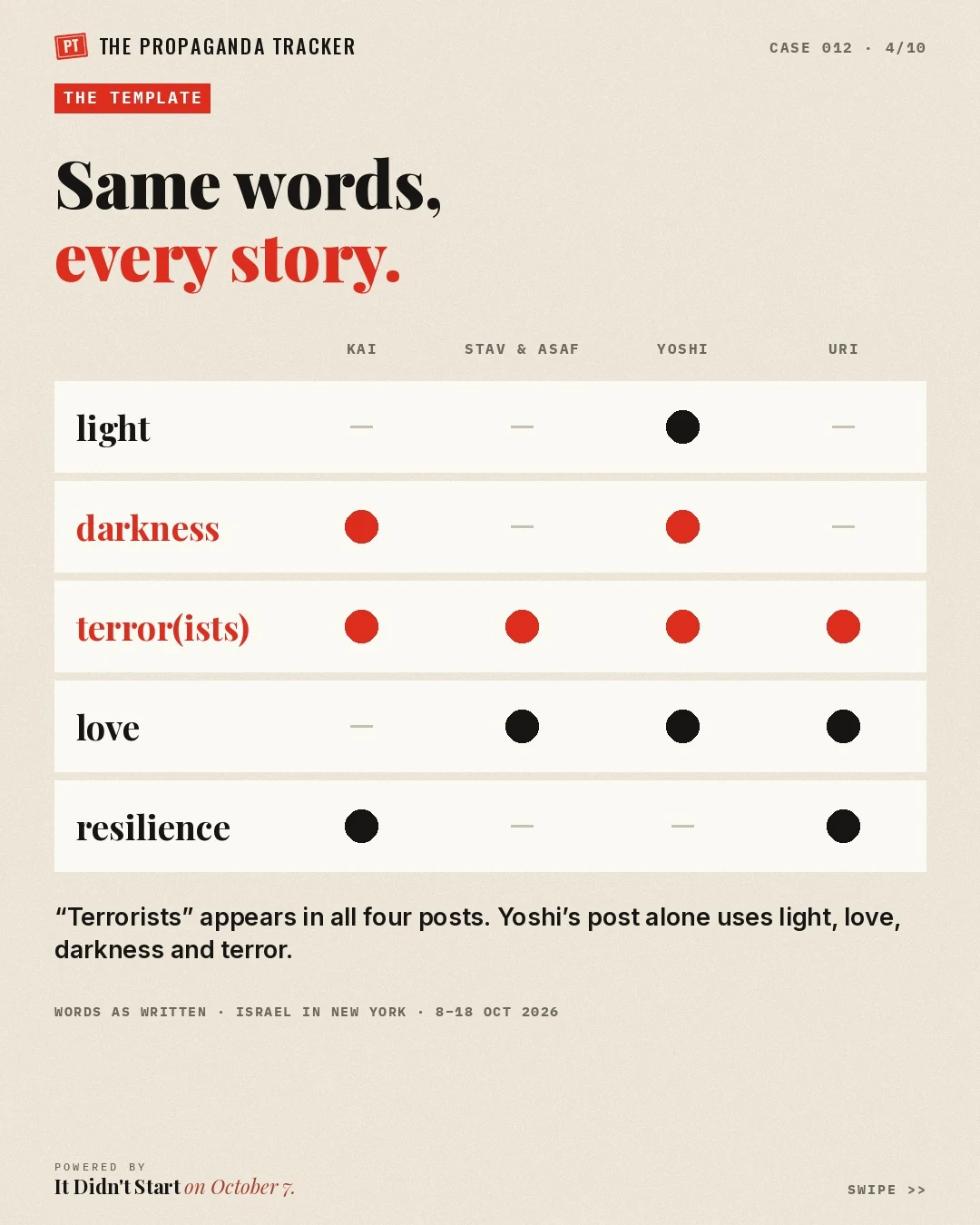
Read the four captions side by side and the same words keep returning. One side gets light, love and resilience. The other side gets darkness and terror.[2]
| Word, as written | Kai · 8 Oct | Stav & Asaf · 11 Oct | Yoshi · 17 Oct | Uri · 18 Oct |
|---|---|---|---|---|
| light | – | – | “Light will always triumph over darkness.” | – |
| darkness | “refusal to let darkness win” | – | “…over darkness.” | – |
| terror / terrorists | “Hamas terrorists” | “Hamas terrorists” | “Hezbollah terrorists”; “Love will always prevail over terror.” | “Terrorists” |
| love | – | “fell in love” | “the love of his life”; “Love will always prevail…” | “A love story of resilience” |
| resilience | “a symbol of resilience” | – | – | “A love story of resilience” |
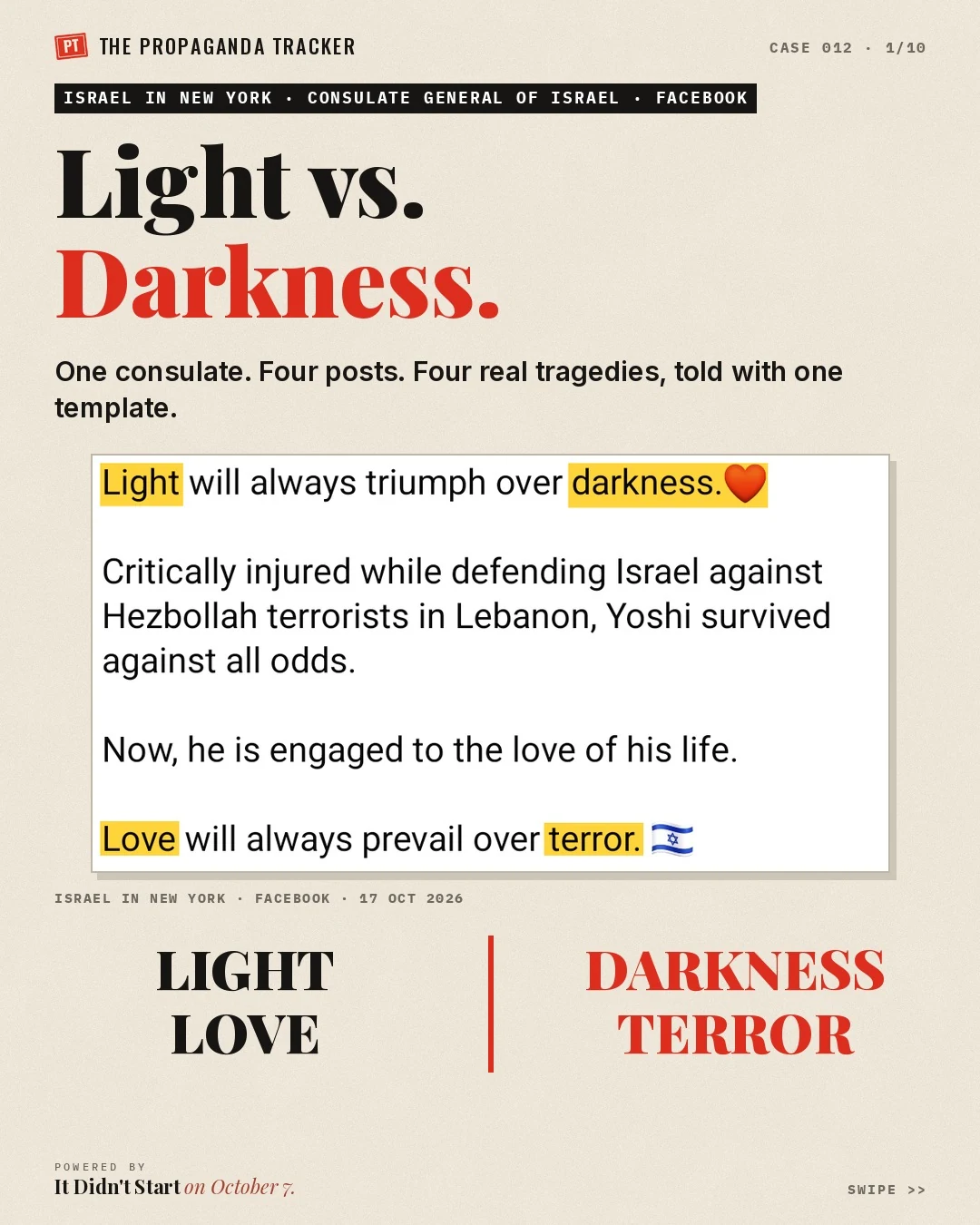
The template erases a distinction. Kai was ten days old, at home in Nirim. Yoshi was a soldier, wounded, in the page’s words, “defending Israel against Hezbollah terrorists in Lebanon.”[2] A baby attacked in his home and a soldier wounded in combat in another country are given the same story: light against darkness.
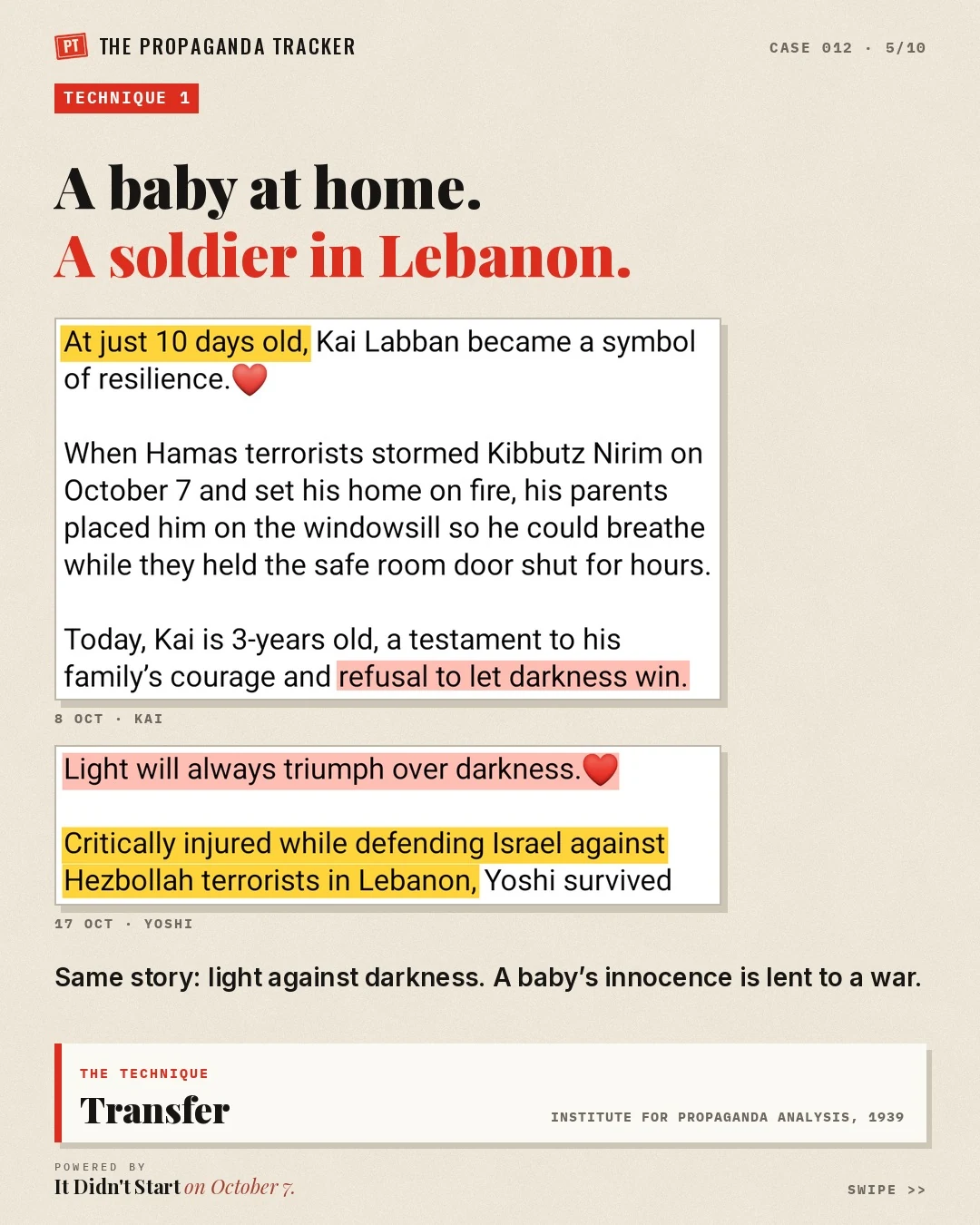
Transfer: a baby’s innocence, lent to a war
In 1939, the Institute for Propaganda Analysis listed transfer among its seven propaganda devices: carrying the feeling attached to one thing over to another.[10] Here, the innocence of civilian victims of 7 October is placed in the same frame as soldiers wounded in combat, including inside Lebanon. The feeling moves with the frame.
The oldest script: Ponsonby and Morelli’s principles of war propaganda
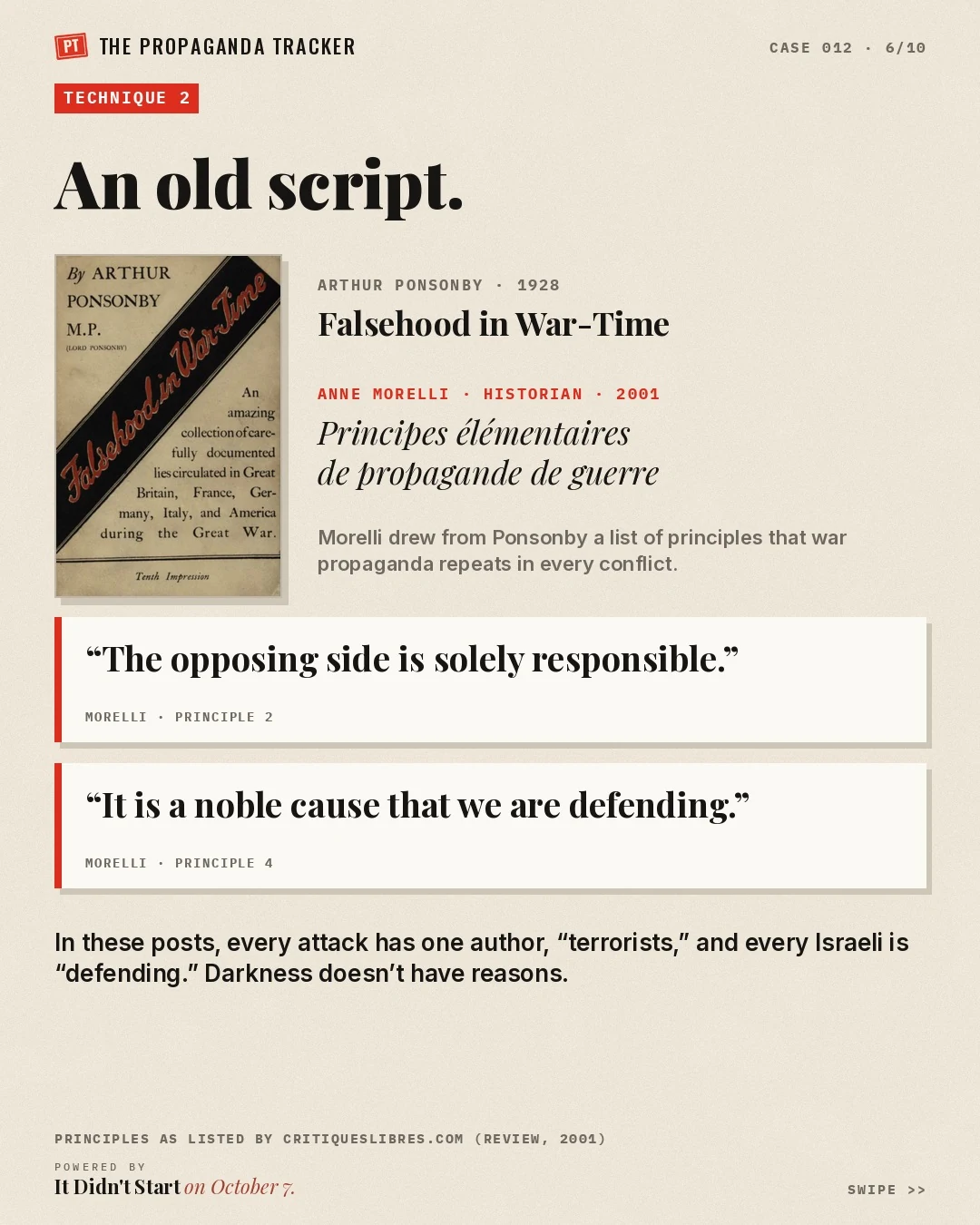
In 1928, the British politician Arthur Ponsonby published Falsehood in War-Time, a catalogue of the lies circulated by all sides in the First World War.[13] In 2001, the Belgian historian Anne Morelli drew from that work a short list of principles that war propaganda repeats in every conflict, in Principes élémentaires de propagande de guerre.[11] Two of them describe this template exactly:[12]
Like most war propaganda techniques, these work by what they leave unsaid. The posts never explain why anyone fired at anyone. Every attack has one author, the “terrorists,” and every Israeli in the frame is “defending.” Light against darkness leaves no room for causes, because darkness doesn’t have reasons.
October 7th itself: the Hannibal Directive and the army’s own inquiry
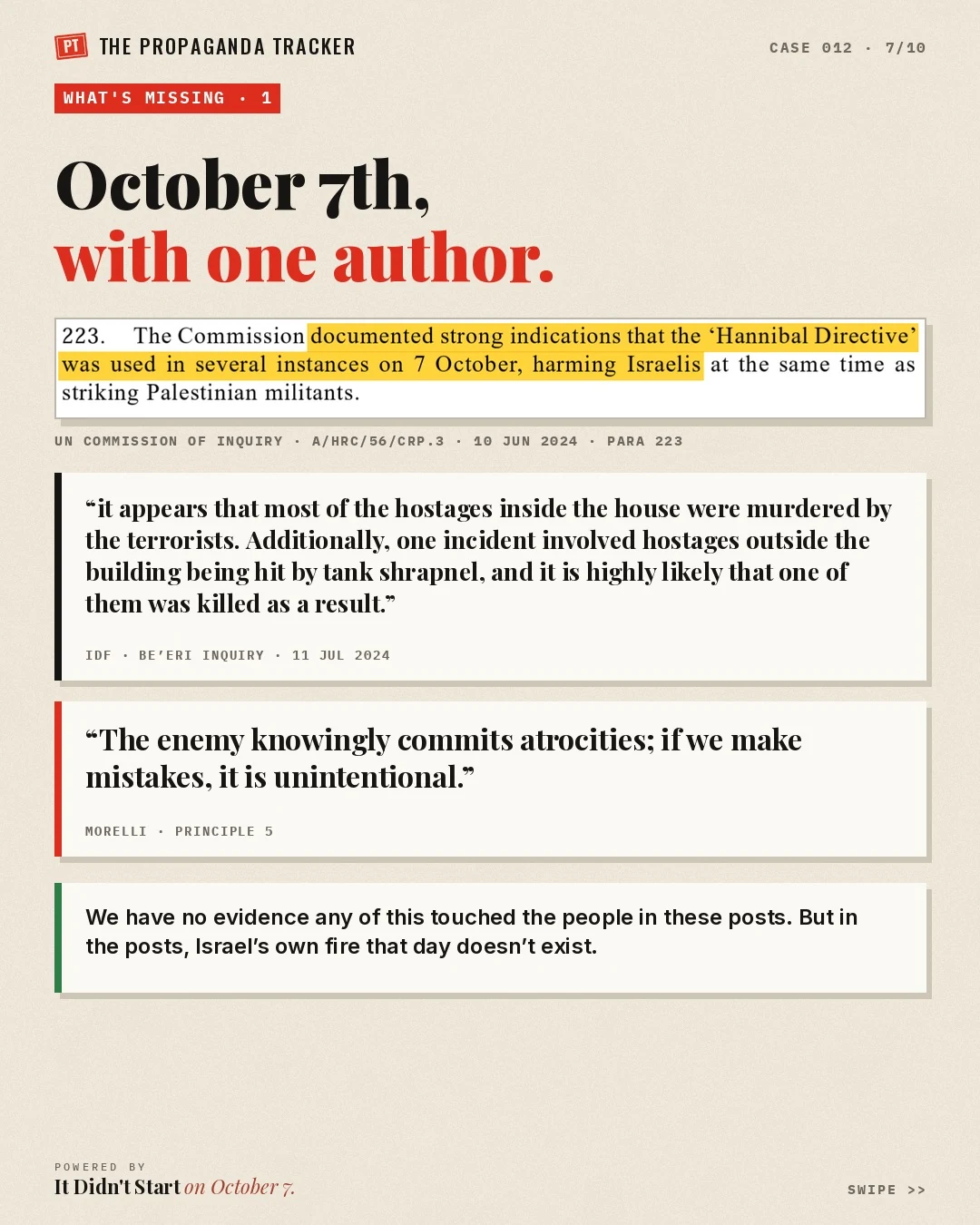
Two of the posts are about 7 October. Neither mentions what Israeli investigators and a UN commission later documented about Israel’s own fire that day.
Haaretz, an Israeli newspaper, reported a month later that at 11:22 a.m. the order across the Gaza Division network was: “Not a single vehicle can return to Gaza.” Its investigation found the Hannibal order “was employed at three army facilities infiltrated by Hamas, potentially endangering civilians as well.”[4]
On 11 July 2024, the army presented its own inquiry into the battle for Kibbutz Be’eri, including a house where dozens of attackers held hostages. Its conclusions cut both ways, and we quote both:[5]
Where we draw the line.
We have no evidence that any of this touched the people in these posts. The UN commission confirmed that Israeli helicopters were present over the Nova festival site, but it was “unable to confirm whether these helicopters directed firepower at any actual targets in the Nova area, vehicles or otherwise.”[3] We make no claim about how Stav Barazani and Asaf Edberg died beyond what the page says. Our point is about the posts: in them, Israel’s own fire that day doesn’t exist.
Morelli’s fifth principle names this omission:[12]
Before October 7th: the blockade and the occupation
In these posts, the story starts on 7 October. The record starts earlier. OCHA, the UN’s humanitarian office, describes Israeli movement restrictions on Gaza since the early 1990s, which “intensified in June 2007, following the takeover of that part of the occupied Palestinian territory (OPT) by Hamas, when Israel imposed a land, sea and air blockade on Gaza, citing security concerns.” OCHA adds that Gaza’s isolation was “exacerbated by restrictions imposed by the Egyptian authorities on Rafah.”[7]
On 19 July 2024, the International Court of Justice concluded in an advisory opinion that “the State of Israel’s continued presence in the Occupied Palestinian Territory is unlawful.”[6]
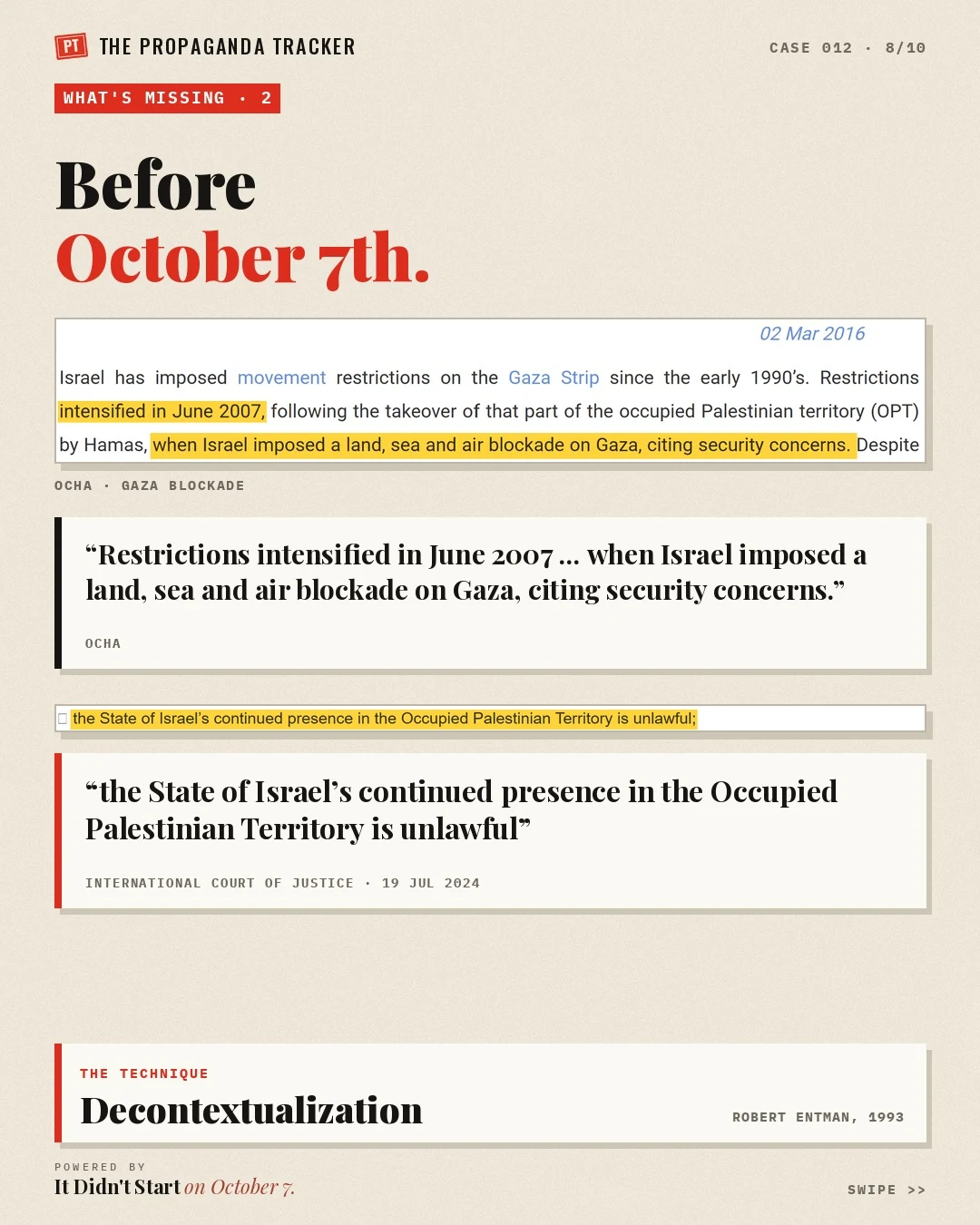
This is decontextualization, a technique in our framework: reporting an event without the context that would change its meaning. Robert Entman’s classic work on framing explains why omission matters: what a frame leaves out “may be as critical as the inclusions in guiding the audience.”[14]
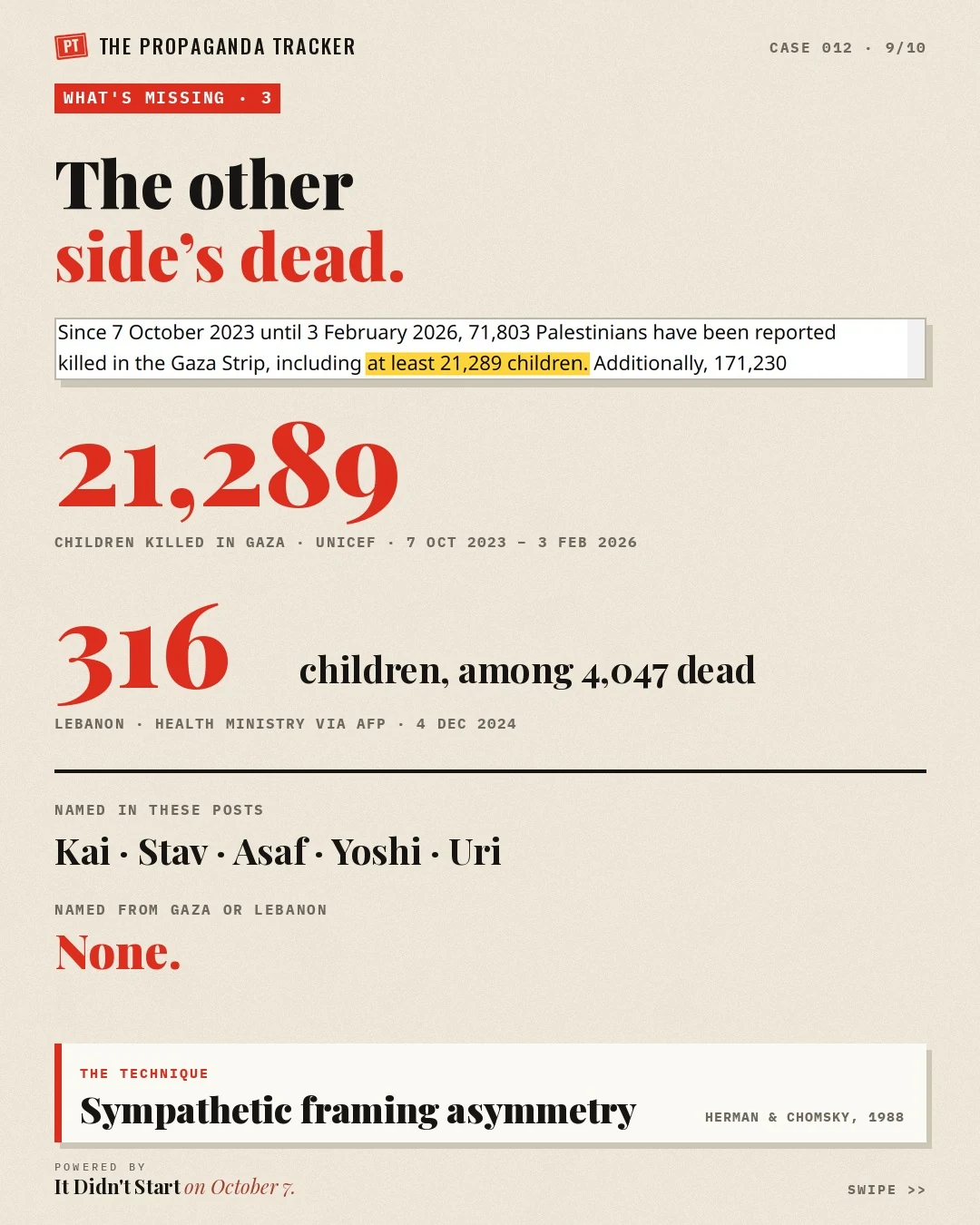
The other side’s dead: named victims and unnamed numbers
The page names every victim it shows: Kai, Stav, Asaf, Yoshi, Uri. Each has a face, an age or a love story. The war has other dead.
In Lebanon, a week after the November 2024 ceasefire, Health Minister Firass Abiad reported 4,047 dead and 16,638 wounded; “316 children and 790 women were among the dead.”[9] The ministry’s figure does not separate fighters from civilians.
Not one of them appears in these posts. Our framework calls this sympathetic framing asymmetry: humanizing one side’s victims with names, ages and details while the other side’s appear only in aggregate, or not at all. It is the pattern Edward Herman and Noam Chomsky described in 1988 as “worthy” and “unworthy” victims.[15]
What the posts say, and what they leave out
War propaganda techniques: the checklist
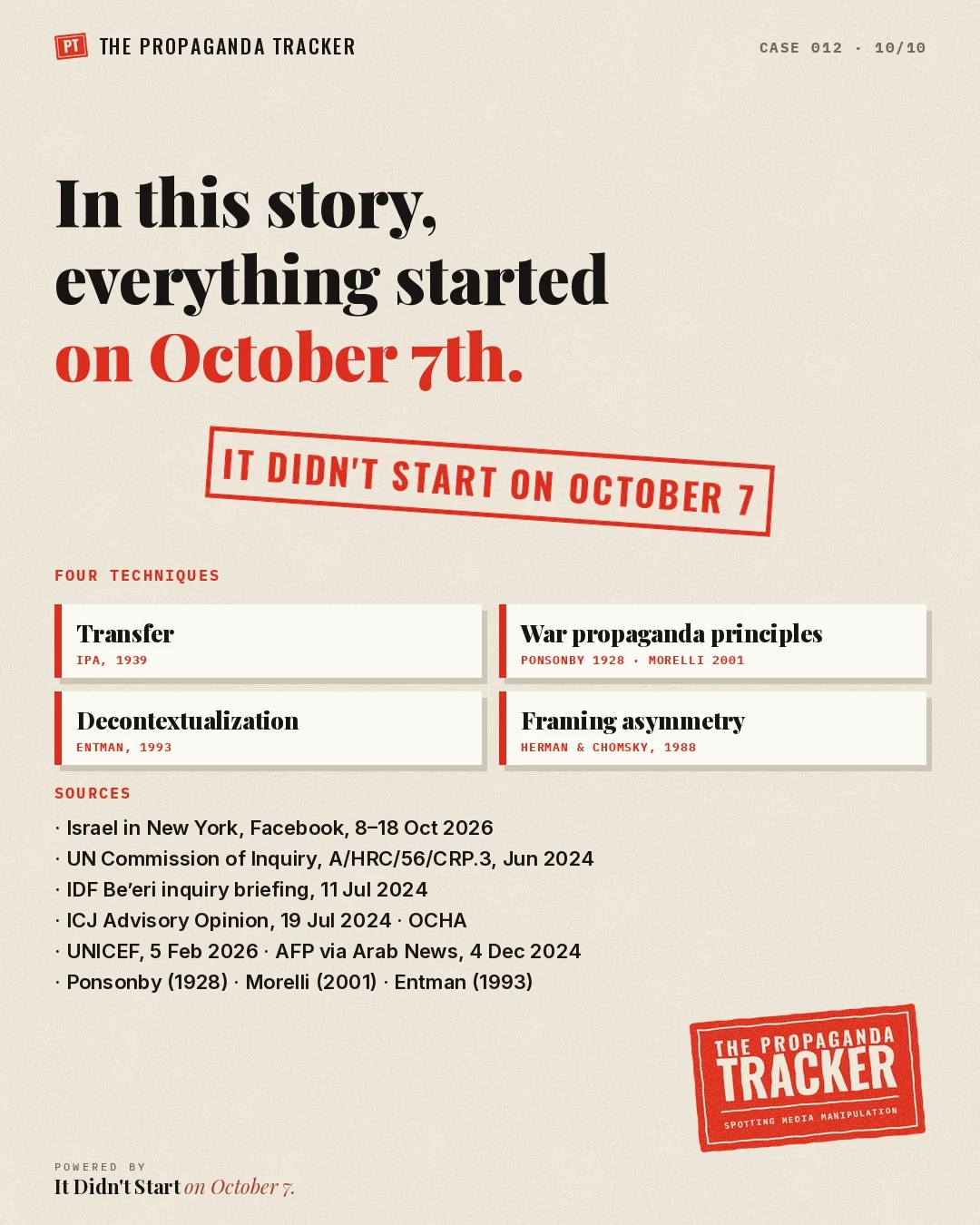
It didn’t start on October 7th
None of these four posts says anything false about the people in it. Kai’s home was set on fire. Stav and Asaf were murdered. Yoshi and Uri were badly wounded. The manipulation is not in the facts. It is in the frame around them: one side gets light and love, the other gets darkness and terror, and the war in between disappears.
Of all the war propaganda techniques in this case, that is the media literacy lesson to keep. When a story assigns its moral roles before it tells you what happened, ask what happened before it begins, and who is missing from it. In this story, everything started on October 7th.
- Facebook showed the 17 and 18 October posts with relative timestamps (“2 days ago,” “6 hours ago”). Their dates were confirmed by the person who captured them; the 8 and 11 October dates appear on the posts.
- The page gives only a first name for Yoshi and doesn’t say where Uri Asher was wounded. We make no claims about either man beyond what the posts state.
- We quote Morelli’s principles in English from a 2001 review that lists them, not from our own translation of the book.
- The army’s Be’eri findings are its own assessment, which it described as “a developing inquiry.” We quote both its finding that most hostages in the house were murdered by the attackers and its finding about the tank shrapnel.
- The Lebanese Health Ministry figure (4,047) does not separate fighters from civilians. UNICEF’s Gaza figures cover 7 October 2023 to 3 February 2026.
- This case study analyzes framing. It makes no claim about the intent of the page’s authors.
War propaganda: quick answers
What is the transfer propaganda technique?
Transfer, listed by the Institute for Propaganda Analysis in 1939, carries the feeling attached to one thing over to another. In these posts, the innocence of civilian victims is placed in the same frame as soldiers wounded in combat.
What are Anne Morelli’s principles of war propaganda?
In 2001, the Belgian historian Anne Morelli listed principles that war propaganda repeats in every conflict, drawing on Arthur Ponsonby’s Falsehood in War-Time (1928). They include “The opposing side is solely responsible” and “It is a noble cause that we are defending.”
What is the Hannibal Directive?
An Israeli military order meant to prevent soldiers being taken captive, including by force. A UN Commission of Inquiry documented “strong indications” that it was used in several instances on 7 October 2023, harming Israelis.
Does this article say the posts are false?
No. The facts about the people in the posts are not disputed. The case study analyzes the frame around them and what it leaves out, and makes no claim about the page’s intent.
This case was first published as Case 012 of The Propaganda Tracker. To document is to resist erasure.
On what happened on 7 October itself, including the Hannibal Directive: The Attack Proceeds. On the context these posts leave out: The Myth That “It Started on October 7”.
More cases from The Propaganda Tracker: The Letter: What the Israeli Army Cut From a Child’s Words (Case 011) and Does Ms Rachel Spread Hate? (Case 010). Transfer, decontextualization and sympathetic framing asymmetry are catalogued, with their research, in the Propaganda Technique Database.
See how we verify claims on this site.