Myth Debunking Propaganda Literacy Humans in Palestine Sources & Documents Observatory Evidence File Confessions
Methodology
Case Study
Fear Appeal

What’s Scarier? How an IDF Post Uses Fear Appeal Propaganda

“What's scarier?” A four-slide IDF post climbs from a soldier's fear to the fear of losing a country, and lands on one answer: the army.

Techniques identified: Fear appeal Transfer Principles of war propaganda Framing asymmetry
Verdict
Techniques identified — Fear appeal (new) · Transfer · The principles of war propaganda · Framing asymmetry. The event: a four-slide post on the Israel Defense Forces’ Facebook page, 22 October 2026. 11 citations.

“Operating in active combat zones is scary, but you know what’s scarier?” A four-slide post from the Israel Defense Forces climbs from a soldier’s fear to the fear of losing a country, and lands on one answer: the army. This case study names the fear appeal propaganda behind it, and asks the question the post never does: whose civilians?

01 · The post

An army post in four slides

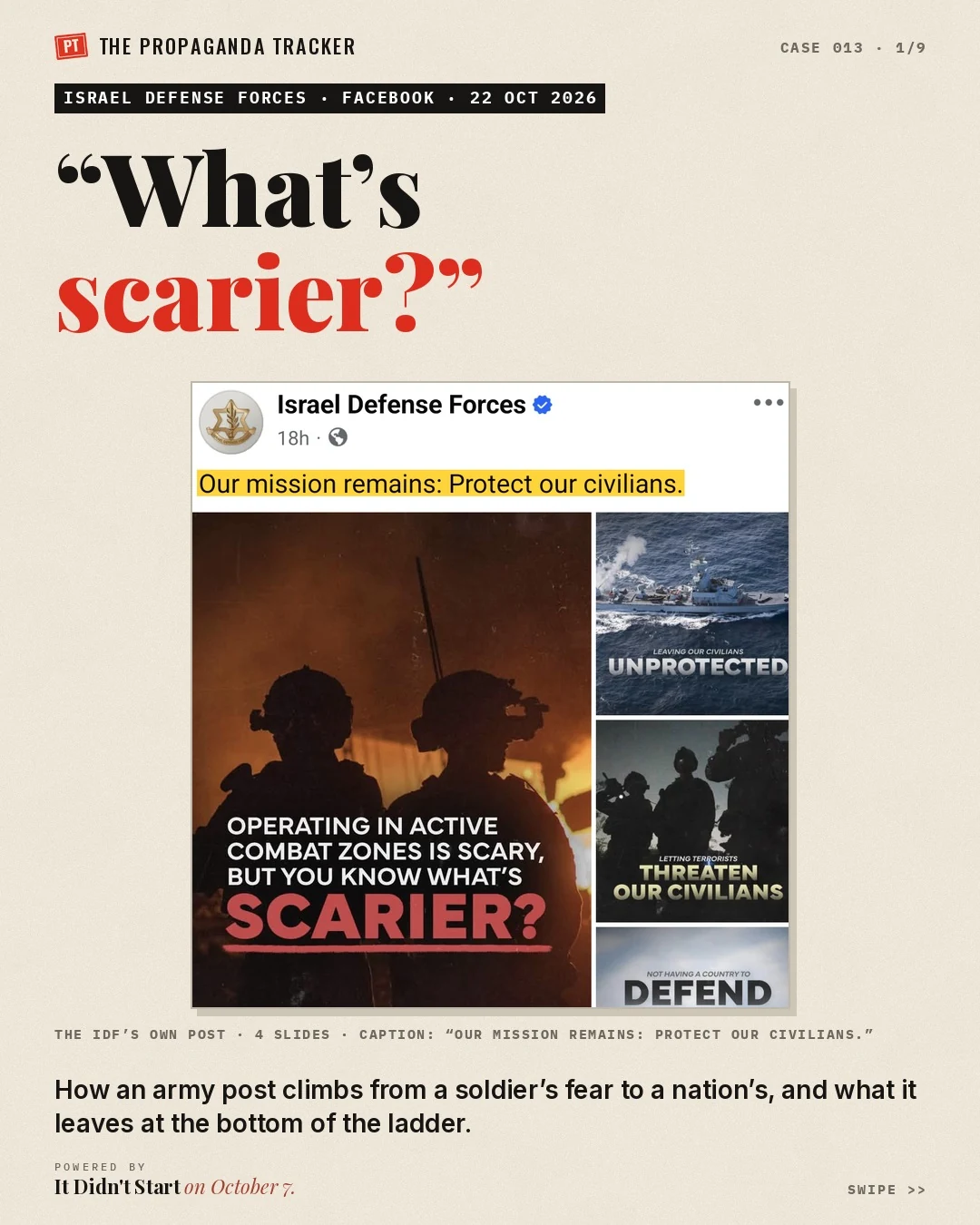
On 22 October 2026, the Israel Defense Forces published a four-slide post on its verified Facebook page with one line of caption: “Our mission remains: Protect our civilians.”[1] Read in order, the slides form one sentence:
Israel Defense Forces
“Operating in active combat zones is scary, but you know what’s scarier? Leaving our civilians unprotected. Letting terrorists threaten our civilians. Not having a country to defend.”
Facebook, 22 Oct 2026 [1]
IDF Facebook post asking “What’s scarier?”, an example of fear appeal propaganda, with the caption “Our mission remains: Protect our civilians”
The post, with its caption. Source: Israel Defense Forces, Facebook, 22 Oct 2026.
Case 013 of The Propaganda Tracker, a side project of It Didn’t Start on October 7. Watch on YouTube.
02 · Technique one

A ladder of fear: how fear appeal propaganda works

Each slide raises the stakes. The first fear belongs to soldiers. The second is fear for civilians. The third names an enemy. The fourth is the fear of extinction: “not having a country to defend.” By the top of the ladder, the only thing standing between the reader and the end of the nation is the army.
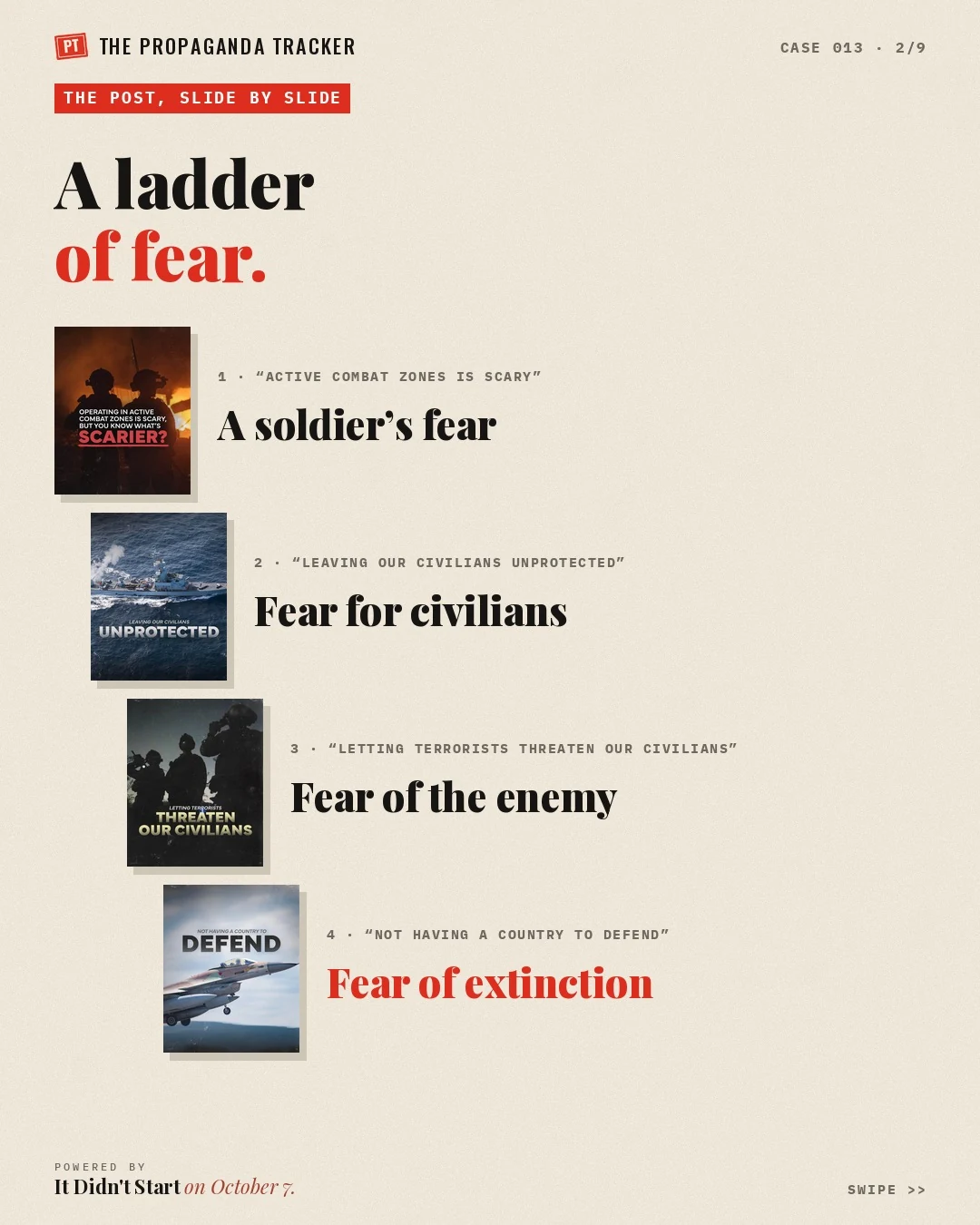
The four IDF slides as a ladder of fear: a soldier's fear, fear for civilians, fear of the enemy, fear of extinction
The four slides, in order. Source: Israel Defense Forces, Facebook, 22 Oct 2026.

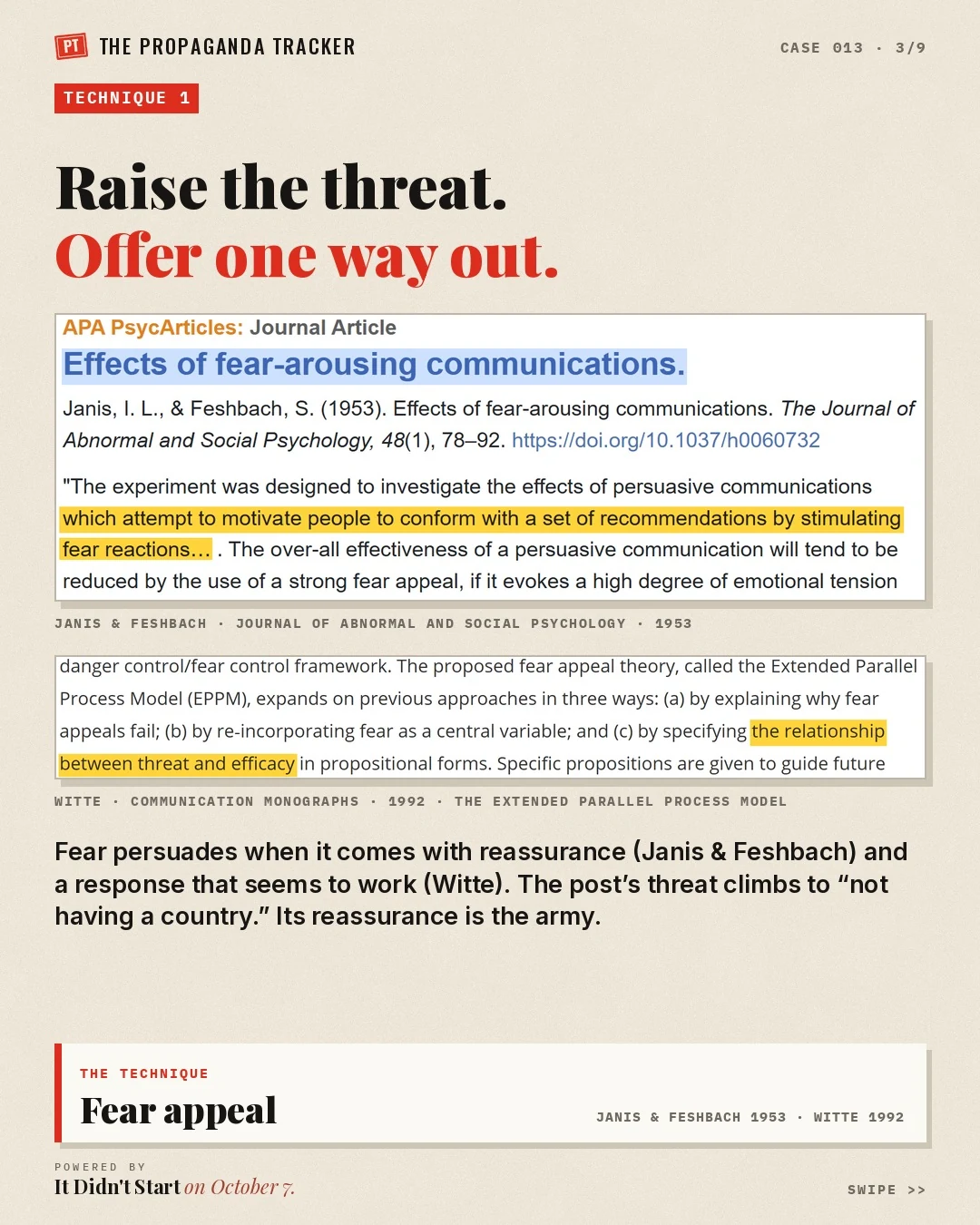
Psychologists have studied this kind of message for more than seventy years. In 1953, Irving Janis and Seymour Feshbach published the first experiment on persuasive communications “which attempt to motivate people to conform with a set of recommendations by stimulating fear reactions.” They found that the effectiveness of a persuasive message tends to be reduced by a strong fear appeal “if it evokes a high degree of emotional tension without adequately satisfying the need for reassurance.”[2]

In 1992, Kim Witte’s extended parallel process model explained when fear works and when it fails: it depends on “the relationship between threat and efficacy,” the size of the danger and whether the audience believes there is a response that works.[3]
In plain language
Fear persuades when it comes with a way out. This post supplies both: the threat grows to the loss of the country, and the reassurance is the army whose “mission remains: Protect our civilians.”
Fear appeal research: Janis and Feshbach 1953 and Witte's extended parallel process model 1992
Janis & Feshbach (1953); Witte (1992).
03 · Technique two

Transfer: weapons, labelled as protection

Three of the slides show weapons: a warship firing, troops on night operations, a fighter jet taking off. Navy, ground forces, air force. Over all three sits one caption about protecting civilians.[1]

The Institute for Propaganda Analysis called this transfer in 1939: carrying the feeling attached to one thing over to another.[4] The warmth of “protecting civilians” is carried over to the hardware. Nothing in the post says where the weapons are used, or on whom.
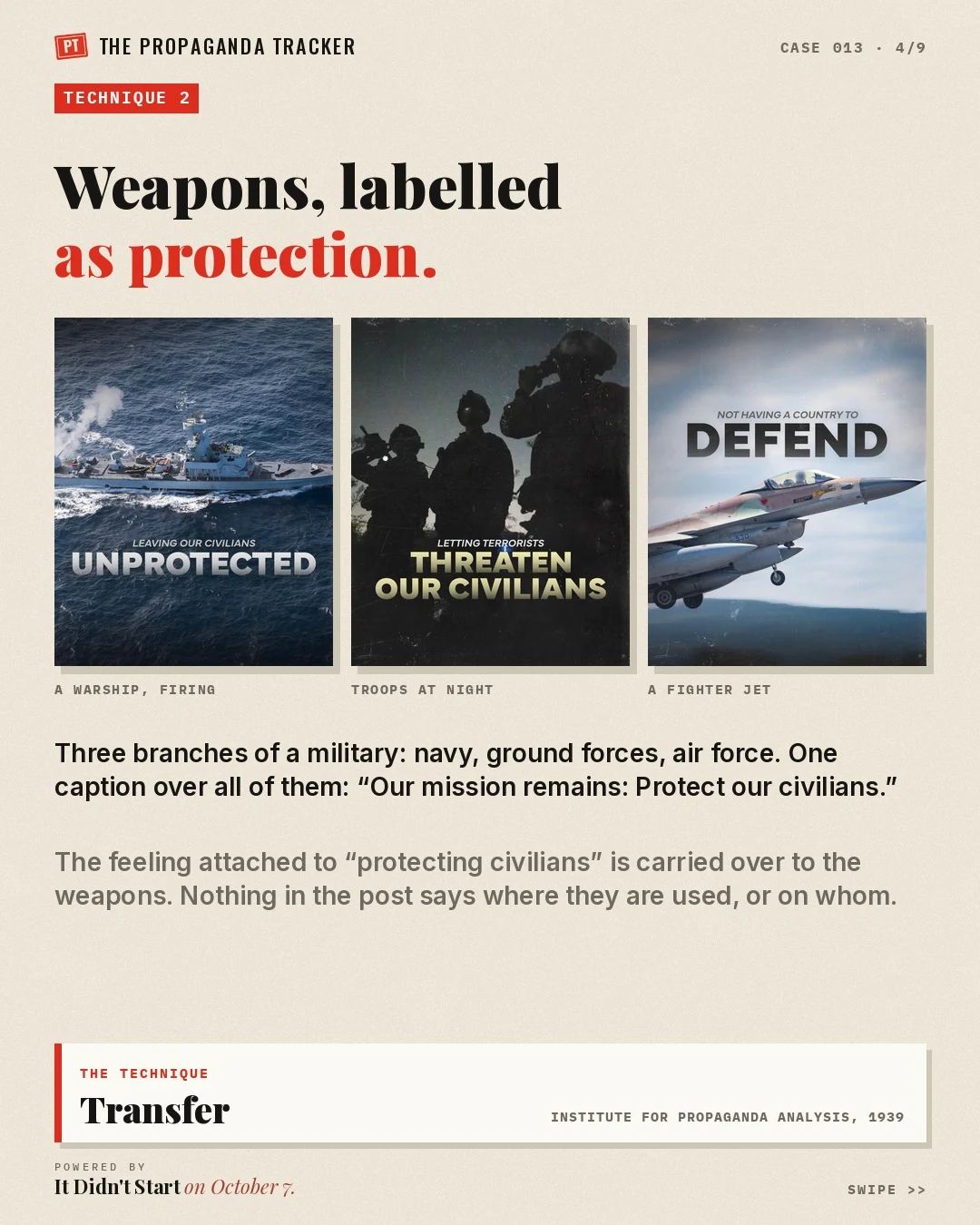
Transfer propaganda technique: a warship, troops and a fighter jet labelled as protection in an IDF post
Three branches of the military, one label. Source: Israel Defense Forces, Facebook, 22 Oct 2026.
04 · Technique three

“Our mission remains”: the principles of war propaganda

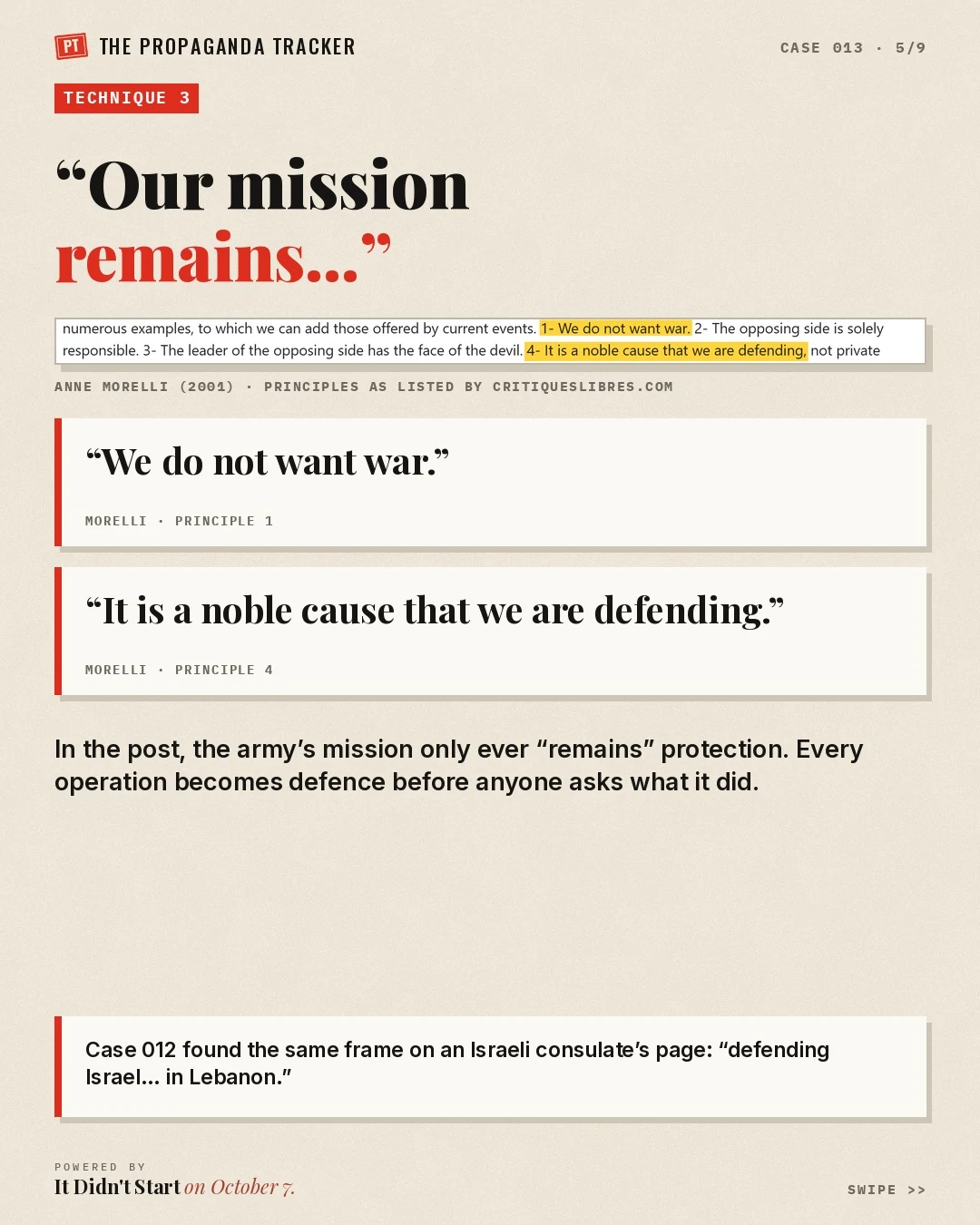
In 2001, the Belgian historian Anne Morelli drew from Arthur Ponsonby’s Falsehood in War-Time (1928) a list of principles that war propaganda repeats in every conflict.[5] The first and fourth describe this caption:[6]

Anne Morelli — principle 1
“We do not want war.”
As listed by Critiques Libres[6]
Anne Morelli — principle 4
“It is a noble cause that we are defending.”
As listed by Critiques Libres[6]

In the post, the army’s mission only ever “remains” protection. Every operation becomes defence before anyone asks what it did.
Pattern connection
Last week, Case 012 found the same frame on the page of Israel’s Consulate General in New York, where a soldier was “defending Israel against Hezbollah terrorists in Lebanon.”[11] This time, the army says it in its own voice.
Anne Morelli's principles of war propaganda: We do not want war; It is a noble cause that we are defending
Morelli’s principles 1 and 4, as listed in a 2001 review.
05 · Where we draw the line

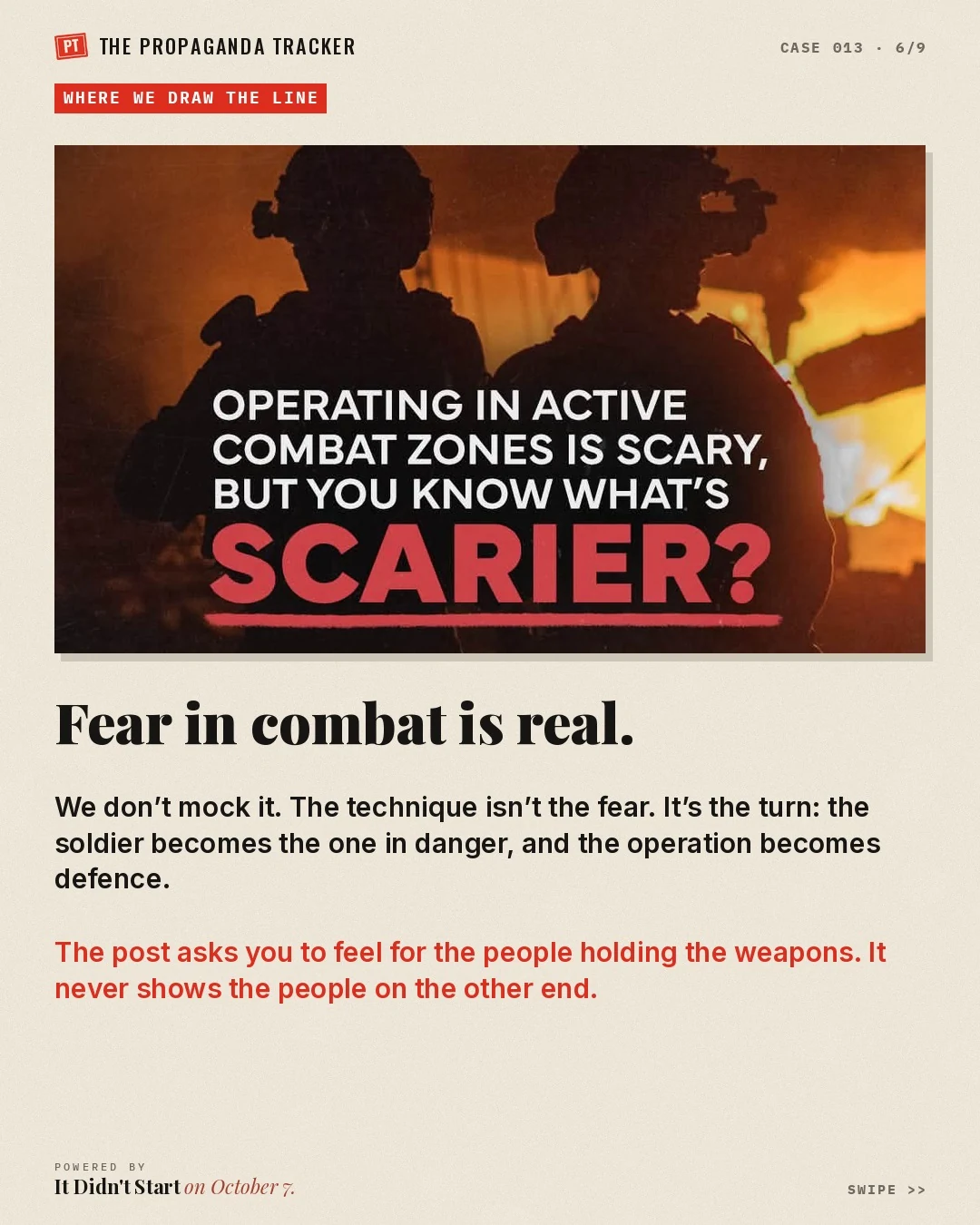
Fear in combat is real

Soldiers in combat are afraid, and saying so is not propaganda. We don’t mock it. The technique isn’t the fear. It’s the turn the post makes with it: the soldier becomes the one in danger, and the operation becomes defence.

The post asks readers to feel for the people holding the weapons. It never shows the people on the other end.
IDF slide: operating in active combat zones is scary; fear in combat is real, the technique is the turn
Slide 1 of the IDF post. Source: Israel Defense Forces, Facebook, 22 Oct 2026.
06 · What’s missing, part one

Whose civilians? The International Court of Justice

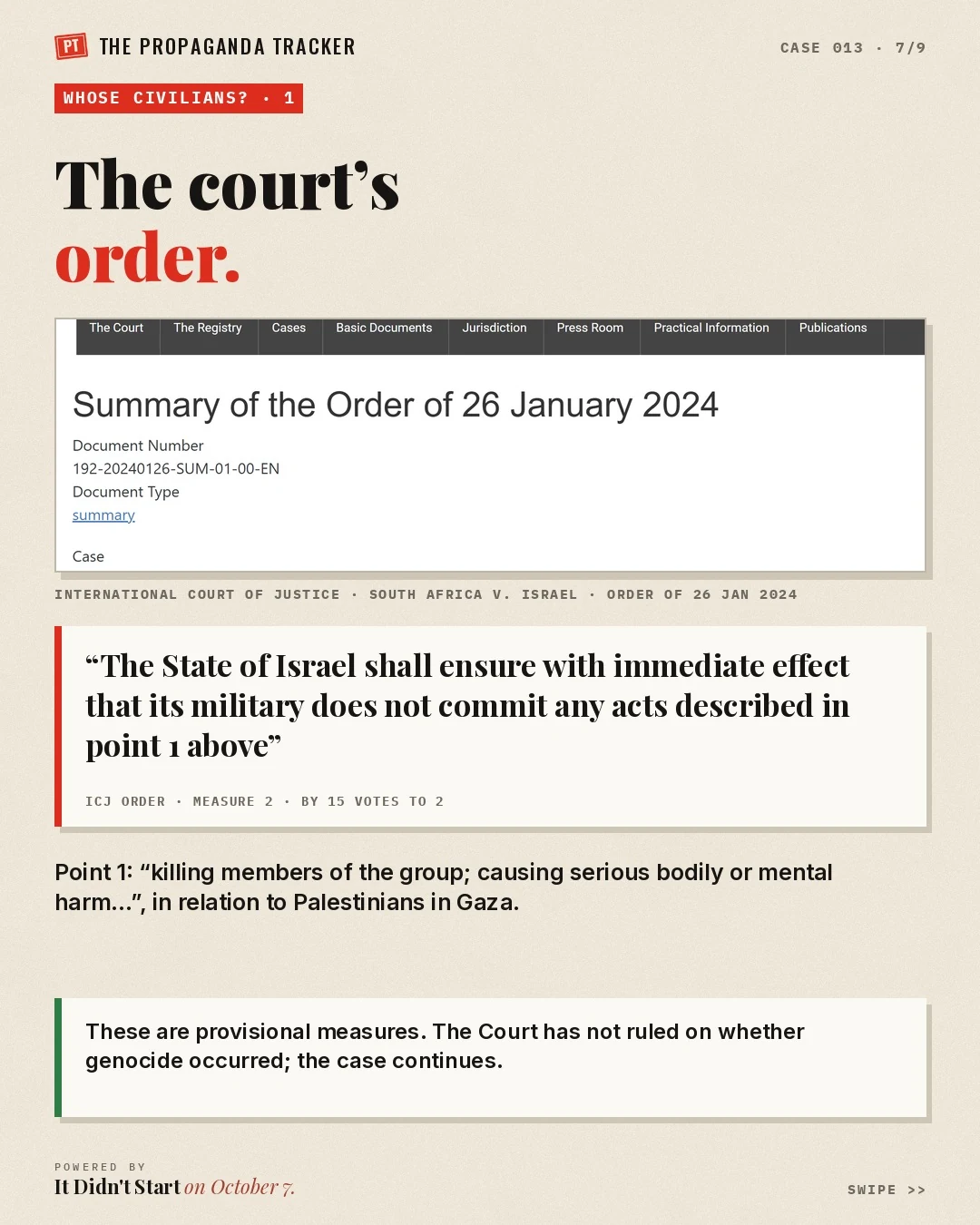
The post says “our civilians” three times. It never mentions the civilians the same military operates among. On 26 January 2024, in South Africa’s case against Israel under the Genocide Convention, the International Court of Justice ordered provisional measures. By fifteen votes to two:[7]
International Court of Justice
“The State of Israel shall, in accordance with its obligations under the Convention on the Prevention and Punishment of the Crime of Genocide, in relation to Palestinians in Gaza, take all measures within its power to prevent the commission of all acts within the scope of Article II of this Convention…”
Order of 26 January 2024, measure 1 [7]
International Court of Justice
“The State of Israel shall ensure with immediate effect that its military does not commit any acts described in point 1 above.”
Order of 26 January 2024, measure 2 [7]
What the order is, and isn’t
These are provisional measures. The Court has not ruled on whether genocide occurred; the case continues. What the order shows is that the world’s highest court addressed the conduct of this military toward Palestinian civilians, the civilians the post leaves out.
ICJ order of 26 January 2024 in South Africa v. Israel: Israel shall ensure its military does not commit acts under the Genocide Convention
ICJ, Summary of the Order of 26 January 2024.
07 · What’s missing, part two

The civilians on the other end

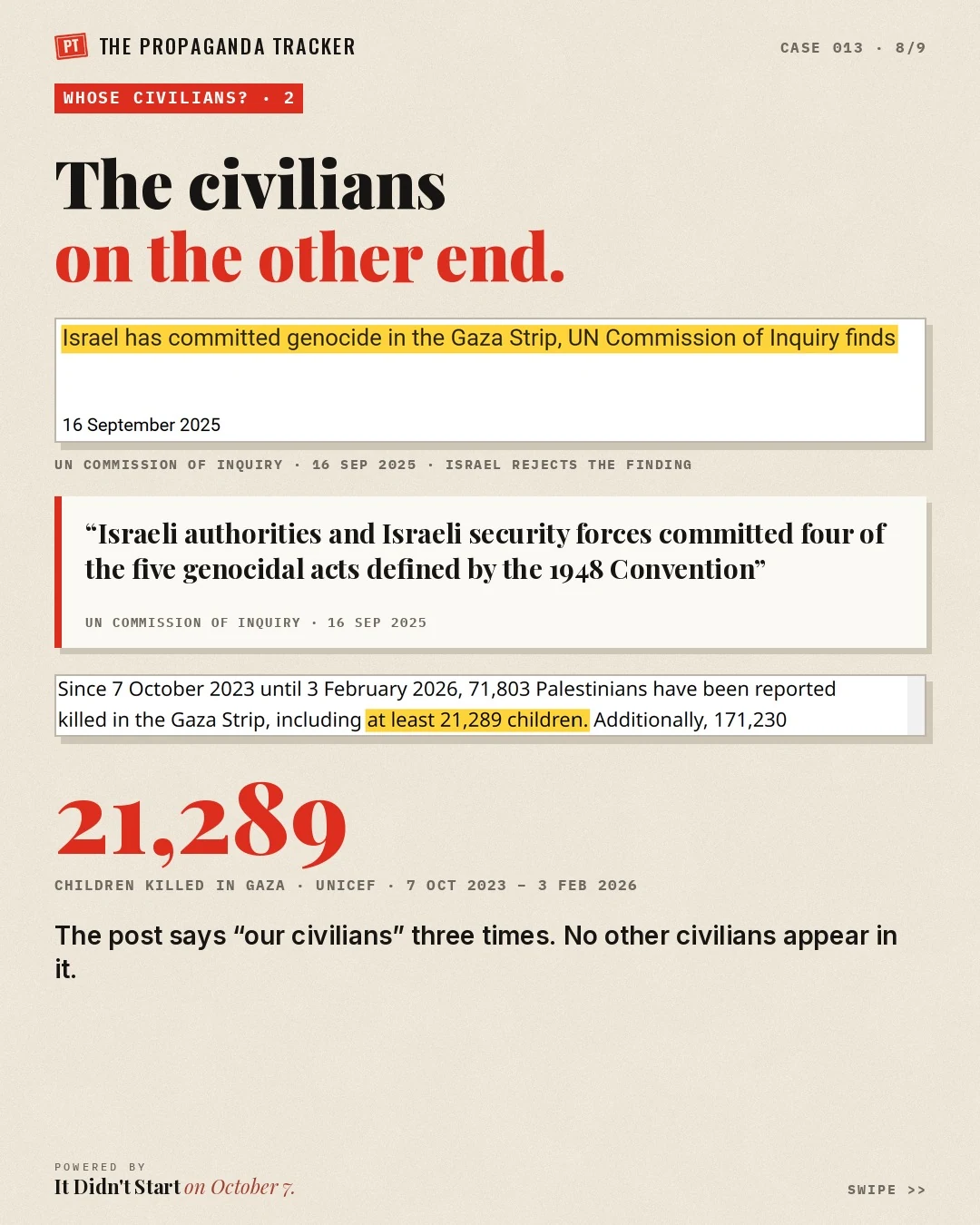
On 16 September 2025, the UN Independent International Commission of Inquiry concluded that “Israeli authorities and Israeli security forces committed four of the five genocidal acts defined by the 1948 Convention on the Prevention and Punishment of the Crime of Genocide.”[8] Israel rejects the finding.

UNICEF reports that from 7 October 2023 to 3 February 2026, “71,803 Palestinians have been reported killed in the Gaza Strip, including at least 21,289 children.”[9]

None of them appears in the post. Our framework calls this framing asymmetry: one side’s people are protected, threatened, defended; the other side’s are absent. Edward Herman and Noam Chomsky described the pattern in 1988 as “worthy” and “unworthy” victims.[10]
UN Commission of Inquiry 2025 finding and UNICEF: at least 21,289 children killed in Gaza, absent from the IDF post
UN Commission of Inquiry, 16 Sep 2025; UNICEF, 5 Feb 2026.

What the post says, and what it leaves out

◈ What the post says, and what it leaves out
Each slide vs. the missing piece
The IDF post of 22 October 2026, beside what it leaves out
The post
What it leaves out
The post says
“Operating in active combat zones is scary.”
Fear appeal
The missing piece
Who lives in those combat zones.
The post says
A warship, troops and a jet: “Protect our civilians.”
Transfer
The missing piece
Where the weapons are used, and on whom.
The post says
“Our mission remains: Protect our civilians.”
Morelli, principles 1 and 4
The missing piece
The ICJ ordered Israel to “ensure with immediate effect that its military does not commit” acts under the Genocide Convention. [7]
The post says
“Our civilians,” three times.
Framing asymmetry
The missing piece
At least 21,289 children killed in Gaza (UNICEF); a UN commission’s genocide finding. [9][8]

Fear appeal propaganda and three more techniques: the checklist

◈ Technique checklist
Technique · who documented it · how it shows up here
Technique
Documented by
In this post
Fear appeal
Janis & Feshbach, 1953 · Witte, 1992 [2][3]
A ladder from a soldier’s fear to “not having a country,” with the army as the reassurance.
Transfer
Institute for Propaganda Analysis, 1939 [4]
The feeling of “protecting civilians” carried over to a warship, troops and a fighter jet.
The principles of war propaganda
Ponsonby, 1928 · Morelli, 2001 [5][6]
“We do not want war”; “a noble cause that we are defending.”
Framing asymmetry
Herman & Chomsky, 1988 · Counter-sources: ICJ, UN COI, UNICEF (T1) [10]
“Our civilians” three times; no other civilians at all.
08 · The answer

“Protect our civilians.” Whose?

Nothing in this post is a factual claim that can be checked true or false. That is what makes it effective. It works on feeling: fear first, then reassurance, then a mission that only ever “remains” protection.

That is the media literacy lesson of this case. When a message makes you afraid and then offers you one protector, ask what the protector does, and to whom. Fear appeal propaganda works best when that question never comes up.
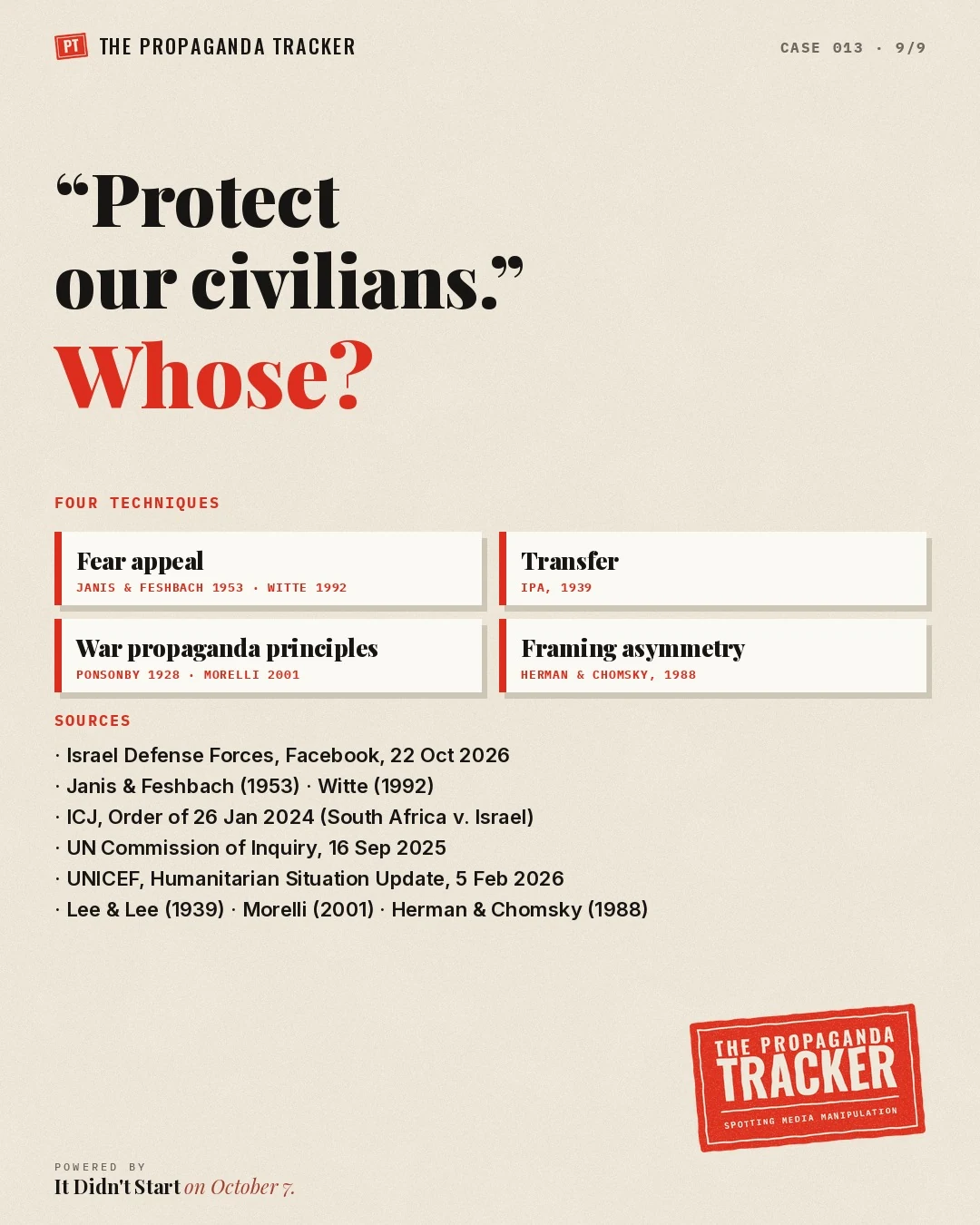
Protect our civilians. Whose? Four techniques of fear appeal propaganda and their sources
The Propaganda Tracker, Case 013.
⚠Limitations of this analysis
  • The ICJ order of 26 January 2024 indicates provisional measures. The Court has not ruled on the merits, and nothing here says it has.
  • Israel rejects the UN Commission of Inquiry’s September 2025 genocide finding.
  • We quote Morelli’s principles in English from a 2001 review that lists them, not from our own translation of the book.
  • The post does not say where its photographs were taken. We make no claim about any specific operation shown.
  • This case study analyzes framing. It makes no claim about the intent of the post’s authors, and it does not dismiss the fear of soldiers in combat.
Frequently asked questions

Fear appeal propaganda: quick answers

What is fear appeal propaganda?

A message that raises fear of a threat and then offers one response as the way out. Janis and Feshbach first tested fear appeals in 1953; Witte’s extended parallel process model (1992) explains that they depend on the balance between threat and efficacy.

What did the ICJ order on 26 January 2024?

In South Africa v. Israel, the Court ordered provisional measures, including that Israel “ensure with immediate effect that its military does not commit” acts under the Genocide Convention. It has not ruled on whether genocide occurred.

Is this article mocking soldiers’ fear?

No. Fear in combat is real. The case study analyzes how the post turns that fear into a frame where every operation is defence.

Sources 11 cited
Analyzed
The post under analysis: four slides and one caption line, published on the IDF's verified Facebook page.
T2
T2
Lee & Lee / Institute for Propaganda Analysis. The Fine Art of Propaganda (1939)
Source of the seven propaganda devices, including transfer.
T2
Anne Morelli. Principes élémentaires de propagande de guerre (Labor, Brussels, 2001)
The list of principles of war propaganda drawn from Ponsonby.
T3
The 2001 review the principles are quoted from, in English and not our translation.
T1
Provisional measures ordered by fifteen votes to two. The Court has not ruled on whether genocide occurred.
T1
The Commission's finding that Israeli authorities and forces committed four of the five genocidal acts. Israel rejects it.
T1
71,803 Palestinians reported killed in Gaza, at least 21,289 of them children (7 Oct 2023 to 3 Feb 2026).
T2
Herman, E. S. & Chomsky, N.. Manufacturing Consent: The Political Economy of the Mass Media (Pantheon, 1988)
The “worthy” and “unworthy” victims framework.
Own
Our earlier case: the same defence frame on the page of Israel's Consulate General in New York.
Note on sourcing tiers
“Analyzed” marks the IDF post this article examines; it is quoted as evidence of what was said. “Own” is our earlier case. Framework and research citations (Janis & Feshbach, Witte, Lee & Lee, Morelli, Herman & Chomsky) are cited for the technique, not as factual sources about Gaza. Tiers follow our methodology.

This case was first published as Case 013 of The Propaganda Tracker. To document is to resist erasure.

Related

More cases from The Propaganda Tracker: Light vs. Darkness (Case 012) and The Letter: What the Israeli Army Cut From a Child’s Words (Case 011).

Fear appeal, transfer, the principles of war propaganda and framing asymmetry are catalogued, with their research, in the Propaganda Technique Database.

See how we verify claims on this site.